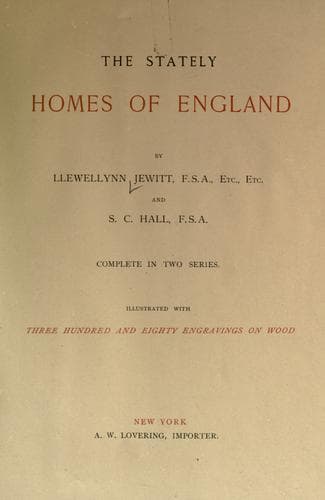
The Stately Homes of EnglandJewitt, Llewellynn Frederick William
History
The Stately Homes of England
Jewitt, Llewellynn Frederick William
Historic buildings -- England
The Privy Garden, on the west side of the mansion, is enclosed within
a high and closely-cut hedge, with a close walk or avenue all around
it. In each of the four angles stood a mulberry tree, said to have been
planted by King James I., and in the centre is a pond surrounded by
rock-work.
The three pairs of splendid entrance-gates, of French metal work, and
of the most elaborate and artistic character, were put up by the late
Marquis of Salisbury in 1846, when Hatfield House was honoured by the
presence of her Majesty and the Prince Consort.
The town of Hatfield presents few objects of antiquity; it stands
on the side of a hill, on the height of which are the gates of the
mansion. Close at hand is the parish church, a structure with little
pretence to architectural beauty.
We may not omit to mention that at the termination of the grounds runs
the clear and beautiful river Lee—here of considerable depth. There is
no bridge to cross to the other side, where are the kitchen gardens of
the house, but a ferry-boat is always at hand.
On a steep above the river is the yew-tree walk—a series of pathways
bordered by the venerable trees, dwarfed generally, but producing a
most agreeable effect.
In all respects, therefore, Hatfield House is largely gifted by Nature
as well as Art.
CASSIOBURY.
CASSIOBURY, or Cashiobury, as it is sometimes spelt, lies about a mile
distant from Watford, in Hertfordshire. It is, therefore, within easy
distance—sixteen miles—from London, and may be considered as one
of the breathing places of denizens of the Metropolis. The name of
Cassiobury is said, and with reason to be derived from the Casii, a
tribe of the Britons who occupied the district, and whose stronghold,
Verulamium, lies only a few miles away. The Casii were, at the time
of the landing of Julius Cæsar, commanded by Cassivelanus, under whom
they fought many battles with the invaders. The hundred is still called
the hundred of Cassio, and the affix of _bury_ evidently signifies an
assemblage of dwellings surrounded by walls, or a burgh or borough.
“Being as its name implies, the only _bury_ within the manor of Cassio
during the Saxon era, it might have been either the seat of justice
for the hundred (for the name _bury_ will admit of this construction),
or an occasional retreat of some of the British princes residing at
Verulamium, of whom Cassivelanus was one,” and by some writers it is
stated to have been “the actual seat or home of Cassivelanus.”
Public-domain text, read in full here on John Shaqi.
Reviews
Reviews
No reviews yet
Be the first to share your thoughts on this work.
Elsewhere in the archive
Join the Discussion
Join the discussion
Sign in to leave a comment or review.
Sign InorCreate an account