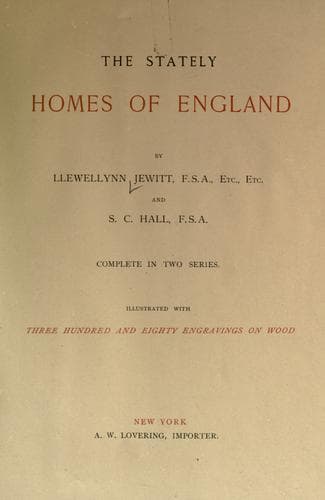
The Stately Homes of EnglandJewitt, Llewellynn Frederick William
History
The Stately Homes of England
Jewitt, Llewellynn Frederick William
Historic buildings -- England
Under the Saxons the manor of Cassio was, it has been stated, among the
numerous possessions of Offa with which he endowed the Abbey of St.
Albans, and it remained attached to that abbey until the dissolution of
the religious houses by Henry VIII. In Domesday Book it is stated that
“the Abbot of St. Albans holds Cassiou; it answers for twenty hides; of
these the abbot holds nineteen. There is land for twenty-two ploughs.
Six hides are in demesne, and there are five ploughs, and a sixth
may yet be made. Three foreigners and thirty-six villeins with eight
bordars have there fifteen ploughs, and one may yet be made. There
are, moreover, three bordars and two bondmen, and four mills of 26_s._
8_d._ Meadow for twenty-two ploughs. Pasture for the cattle. Pannage
for 1,000 hogs. Its whole value is £28; when received £24; and in King
Edward’s time £30. St. Alban held and holds this manor in demesne.”
In the twelfth century the revenue duties payable from Cassio to the
abbey were, at Christmas 2_s._ and twenty-four hens; at Easter, 2_s._
and 600 eggs; and on St. Alban’s day, 2_s._ and twenty-four cheeses.
By Henry I. the whole liberty of Cassio was formally made over to the
abbey. In 1546, after the dissolution of the monasteries, “the lordship
or manor of Cayshobury” and other places was granted to Sir Richard
Morrison, Knight, in consideration of certain property in Yorkshire
and Worcestershire, and of the sum of £176 17_s._ 6_d._ in money; to
hold the same by the service of the tenth part of a knight, and paying
for the same yearly £5 12_s._ 6½_d._ Soon after this, Sir Richard
commenced the erection of “a fayre and large house, situated upon a dry
hill not far from a pleasant river in a fayre park, and had prepared
materials for the finishing thereof; but before the same could be half
built, he was forced to fly beyond the seas.” The mansion was completed
by his son, Sir Charles Morrison, who died in 1599. On the marriage of
Elizabeth Morrison, the only surviving child of Sir Richard’s grandson,
the property passed to her husband, Arthur Capel, created Baron Capel
of Hadham in 1641, from whom the present possessor, the Earl of Essex,
is lineally descended. Baron Capel appears to have resided more at
Hadham than at Cassiobury, but his son, Arthur Capel, created Viscount
Malden and Earl of Essex in 1661, after residing there for a time, took
up his residence at Cassiobury, the greater part of which he is said to
have rebuilt—indeed, it is said that the whole of the mansion, with
the exception of the north-west wing, was rebuilt by him, employing for
the house May, the architect, and for the laying out of his gardens
Moses Cooke—who in 1675 published a volume on fruit-trees—and, it is
also said, Le Notre, and Rose, his head-gardener at Essex House, in the
Strand.
[Illustration: _Back View._]
Public-domain text, read in full here on John Shaqi.
Reviews
Reviews
No reviews yet
Be the first to share your thoughts on this work.
Elsewhere in the archive
Join the Discussion
Join the discussion
Sign in to leave a comment or review.
Sign InorCreate an account