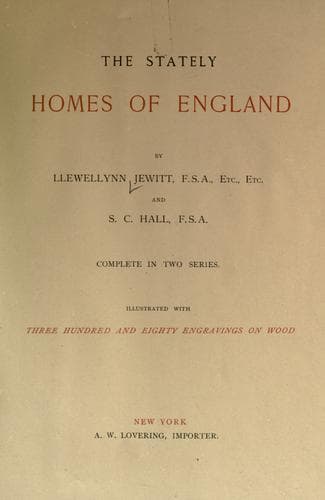
The Stately Homes of EnglandJewitt, Llewellynn Frederick William
History
The Stately Homes of England
Jewitt, Llewellynn Frederick William
Historic buildings -- England
The family of Agard is of very ancient origin in the county of Derby,
being settled at Foston as early as 1310. In the reign of Charles II.
the Foston estate was sold by John Agard, and about the same time,
one of the co-heiresses of Charles Agard, the last heir-male of the
main line, married John Stanhope, of Elvaston, the ancestor of the
Earls of Harrington. Another branch of the Agards settled at Sudbury,
in the same county, and one of them married the heiress of Ferrars,
of Tamworth. The Agards, as feodaries or bailiffs of the honour of
Tutbury, were possessed of a horn (described in the “Archæologia”)
which passed, with the office, to Charles Stanhope, Esq., of Elvaston,
on his marriage with the heiress. Arthur Agard, born at Foston, in
1540, was an able and eminent antiquary, and was one of the members of
the first Society of Antiquaries. His essays read to the Society occur
in Hearne’s “Discourses,” and a treatise by him on the obscure words
in Domesday-book, are, with other papers, in the Cottonian Collection
in the British Museum. He held office as Deputy-Chamberlain of the
Exchequer, and died in 1615. A John Agard founded a chantry at Lupton.
Shortly after acquiring Chatsworth by purchase from the Agards, Sir
William Cavendish pulled down the old Hall of the Leches, and began the
erection of the mansion which, in a few years after its construction,
was destined to become a place of historical interest. Sir William
Cavendish, it appears, died before his plans for building had been
carried out to any great extent; and its completion, on a much larger
scale than he had intended, was left to his widow (who ultimately
became Countess of Shrewsbury), by whom Hardwick Hall and other places
were erected; and of whom it was said that, having a firm belief she
should never die so long as she continued building, kept on year after
year; until at last, a terrible frost coming on, the masons were thrown
out of work, when she languished and died. The mansion, commenced by
Sir William Cavendish, and completed by his widow, was a quadrangular
building, the west front of which had a square tower at each end,
and the entrance, in the centre, was between four angular towers. Of
this front of the building a representation is happily preserved at
Chatsworth, which, through the kindness and courtesy of its noble
owner, the present Duke of Devonshire, we are enabled to engrave.
[Illustration: _The Old Hall as it formerly stood._]
Public-domain text, read in full here on John Shaqi.
Reviews
Reviews
No reviews yet
Be the first to share your thoughts on this work.
Elsewhere in the archive
Join the Discussion
Join the discussion
Sign in to leave a comment or review.
Sign InorCreate an account