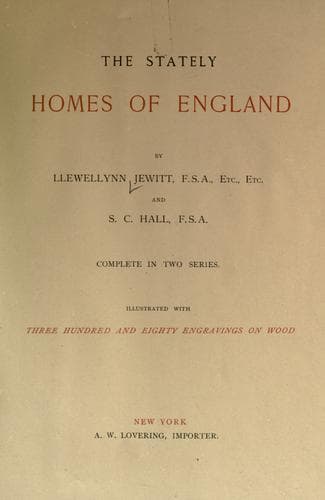
The Stately Homes of EnglandJewitt, Llewellynn Frederick William
History
The Stately Homes of England
Jewitt, Llewellynn Frederick William
Historic buildings -- England
It was in this mansion that that truly unhappy sovereign, Mary, Queen
of Scots, was kept so long a prisoner under the care of the Earl of
Shrewsbury—the suite of rooms occupied by her being on the upper, or
state-room story, of the east side of the quadrangle, and immediately
opposite to the then principal entrance. The unfortunate queen was
first brought captive to Chatsworth in May or June, 1570, from Tutbury
Castle, probably spending a short time on her way at another of the
earl’s residences, Wingfield Manor: here she remained for some months,
and here, it is pleasant to know, the severity of her confinement was
in some degree relaxed; yet the surveillance kept over her by the Earl
of Shrewsbury was enough to disappoint a scheme laid for her release
by two sons of the Earl of Derby, and a Derbyshire gentleman named
Hall. At this time the Queen of Scots’ establishment consisted of
thirty persons, among whom was John Beton, a member of the same family
to which Cardinal Beton belonged. This faithful servant, who was her
“prægustator”—an office in royal households of which frequent mention
is made in the old writers of the Middle Ages—died while Mary was in
captivity at Chatsworth, and was buried in the church of Edensor, close
by, where a monument, which yet remains, was erected by his attached
mistress. Of this monument we shall give an engraving later on. During
this same year at Chatsworth it was that the series of personal
negotiations which kept hope alive in the breast of the fair captive
was commenced, and in which Cecil and Mildmay, who were at Chatsworth
in October, took part. At this time the project of removing her to
Sheffield was mooted, and on his return to court from Chatsworth, Cecil
wrote his memorable letter, allowing her a little horse-exercise about
the grounds of Chatsworth.
“Now for the removing of yt quene, hir Maty said at the first that she
trusted so to make an end in short tyme yt your L. shuld be shortly
ac’qted of hir; nevertheless when I told her Maty that yow cold not
long indure your howshold there for lack of fewell and other thyngs,
and yt I thought Tutbury not so fitt a place as it was supposed, but
yt Sheffield was ye metest, hir Maty sayd she wold thynk of it, and
wtin few dayes gyve me knolledg: Only I see her Maty loth to have
yt Q. to be often removed, supposying that therby she cometh to new
acqueyntance; but to that I sayd Yor L. cold remove hir wtout callying
any to you but your owne. Uponn motiō made by me, at the B. of Ross’s
request, the Q. Maty is pleased yt your L. shall, whan yow see tymes
mete, suffer ye Quene to take ye ayre about your howss on horssback,
so your L. be in copany; and therein I am sure your L. will have good
respect to your owne company, to be suer and trusty; and not to pass
fro yowr howss above one or twoo myle, except it be on ye moores; for
I never feare any other practise of strangers as long as ther be no
corruptiō amongst your owne.”
Public-domain text, read in full here on John Shaqi.
Reviews
Reviews
No reviews yet
Be the first to share your thoughts on this work.
Elsewhere in the archive
Join the Discussion
Join the discussion
Sign in to leave a comment or review.
Sign InorCreate an account