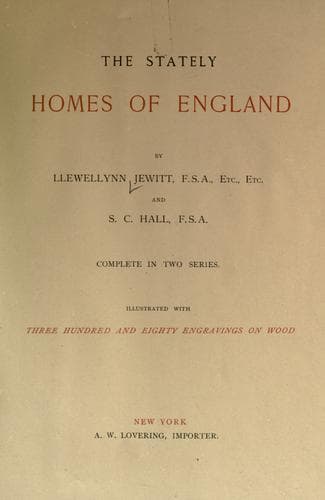
The Stately Homes of EnglandJewitt, Llewellynn Frederick William
History
The Stately Homes of England
Jewitt, Llewellynn Frederick William
Historic buildings -- England
“My Lady Leinstoun, dame of honour to the quene’s Ma^{te}.
M’rez Leinstoun.
M’rez Setoun.
Maistresse Brusse.
M’rez Courcelles.
M’rez Kennett.
My Lord Leinstoun.
M^{re} Betown, mr. howshold.
M^{re} Leinstoun, gentilman servāt.
M^{re} Castel, physition.
Mr Raullett, secretaire.
Bastien, page.
Balthazar Huylly.
James Lander.
Gilbert Courll.
William Douglas.
Jaquece de Sanlie.
Archibald Betoun.
Thomas Archebald.
D—— Chiffland.
Guyon l’Oyselon.
Andro Matreson.
Estien Hauet, escuyer.
Martin Huet, m^{re} cooke.
Piere Madard, potiger.
Jhan de Boyes, pastilar.
Mr. Brusse, gentilman to my Lord Leinstoun.
Nicholl Fichar, servant to my Lady Leinstoun.
Jhon Dumfrys, servant to Maistresse Setoun.
William Blake, servant to Maistresse Courcelles, to serve in absence
of Florence.”
Besides these the following supernumerary servants were kindly allowed
by the earl and approved by the queen:—
“Christilie Hog, Bastiene’s wyff.
Ellen Bog, the Mr cooke’s wyff.
Cristiane Grame, my Lady Leinstoun’s gentilwoman.
Janet Lindesay, M’rez Setoun’s gentilwoman.
Jannette Spetell.
Robert Hamiltoun, to bere fyre and water to the quene’s cuysine.
Robert Ladel, the quene’s lacquay.
Gilbert Bonnar, horskeippar.
Francoys, to serve M^{re} Castel, the phesitien.”
The earl, to insure her safe-keeping, took to himself forty extra
servants, chosen from his tenantry, to keep watch day and night: so
this must, indeed, have been a busy and bustling, as well as an anxious
time, at Chatsworth and at Sheffield.
In the autumn of 1578 Mary was once more at Chatsworth, but in November
was back again, as close a prisoner as ever at Sheffield. Again in 1577
she was, for a short time, at Chatsworth, at which period the Countess
of Shrewsbury was still building there. It was in this year that the
countess wrote to her husband the letter endeavouring to get him to
spend the summer there, in which she uses the strange expressions,
“Lette me here how you, your charge _and love_ dothe, and commende me I
pray you.” In 1581 Mary was again brought to Chatsworth, and probably
was there at other times than those we have indicated. In any case,
the fact of her being there kept a captive, invests the place with a
powerful interest of a far different kind from any other it possesses.
One solitary remain—“Mary Queen of Scots’ Bower”—of this ill-starred
sovereign’s captivity at Chatsworth now exists; to this reference will
be made later on.
Public-domain text, read in full here on John Shaqi.
Reviews
Reviews
No reviews yet
Be the first to share your thoughts on this work.
Elsewhere in the archive
Join the Discussion
Join the discussion
Sign in to leave a comment or review.
Sign InorCreate an account