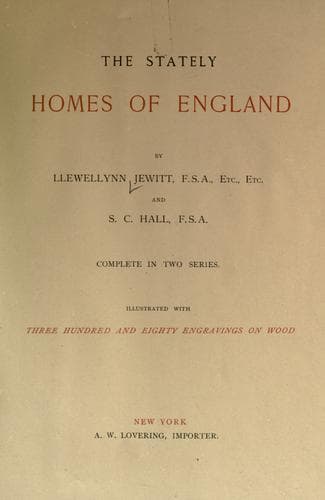
The Stately Homes of EnglandJewitt, Llewellynn Frederick William
History
The Stately Homes of England
Jewitt, Llewellynn Frederick William
Historic buildings -- England
It is also essential here to note, that during these troublous times,
the ill-fated Lady Arabella Stuart—the child of Charles Stuart,
Earl of Lennox, and of his wife Elizabeth Cavendish, daughter of
Sir William Cavendish, by his wife “Bess of Hardwick”—was born at
Chatsworth. The beautiful, much-injured, and ill-fated Lady Arabella,
whose sole crime was that she was born a Stuart, is thus in more ways
than one, like her relative, Mary Queen of Scots, not only mixed up
with Chatsworth, but with the family of its noble possessor. The
incidents of the life of this young, beautiful, and accomplished
lady, which form one of the most touching episodes in our national
history—the jealous eye with which Elizabeth looked upon her from
her birth—the careful watch set over her by Cecil—the trials of
Raleigh and his friends—her troubles with her aunt (Mary, Countess
of Shrewsbury)—her being placed under restraint—her marriage with
Seymour—her seizure, imprisonment, sufferings, and death as a hopeless
lunatic in the Tower of London, where she had been thrown by her
cousin, King James I., are all matters of history, and invest her
short, sad life with a melancholy interest. One of the old ballads to
which her misfortunes gave rise, thus alludes to her connection with
Derbyshire:—
“My lands and livings, so well known,
Unto your books of majesty,
Amount to twelve-score pounds a week,
Besides what I do give,” quoth she.
“In gallant Derbyshire likewise,
I nine-score beadsmen maintain there,
With hats and gowns and house-rent free,
And every man five marks a year.”
During the civil wars the old hall of Chatsworth was taken possession
of, and garrisoned, in 1643, for the Parliament by Sir John Gell,
being then placed under the command of Captain Stafford, from whose
company at Chatsworth in the latter part of the year, forty musqueteers
were ordered to be drafted off, and joined to the army of Fairfax
for his proposed march to Chesterfield and the North. At the end of
the same year the Earl of Newcastle’s forces having taken Wingfield
Manor, and other places in the county, made themselves masters of
Chatsworth (which had been evacuated on his approach to Chesterfield),
and garrisoned it for the king under Colonel Eyre, who the following
spring received reinforcements from Tissington and Bakewell. In
September, 1645, “the governor of Welbecke having gotten good strength
by the kinges coming that way, came to Derbyshire with 300 horse and
dragoones, to sett upp a garrison at Chatsworth, and one Colonel
Shallcross, for governor there. Colonel Gell having intelligence
thereof, sent presently Major Molanus with 400 foott to repossess the
house; and having layn theire 14 days, and hearing of the demolishinge
of Welbecke, Bolsover, and Tickhill castles, was commanded by Colonel
Gell to return to Derby.”
Public-domain text, read in full here on John Shaqi.
Reviews
Reviews
No reviews yet
Be the first to share your thoughts on this work.
Elsewhere in the archive
Join the Discussion
Join the discussion
Sign in to leave a comment or review.
Sign InorCreate an account