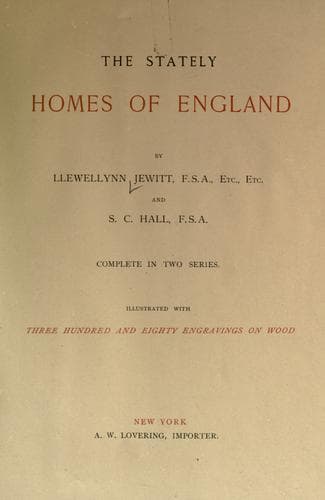
The Stately Homes of EnglandJewitt, Llewellynn Frederick William
History
The Stately Homes of England
Jewitt, Llewellynn Frederick William
Historic buildings -- England
A little before these troublous times, in 1636, Thomas Hobbes, best
known as “Leviathan Hobbes” or “Hobbes of Malmesbury,” who, before
he was twenty years of age, became tutor to the sons of Sir William
Cavendish (then recently created Baron Cavendish of Hardwick), and who
lived and died in the family, thus wrote of the beauty of Chatsworth,
and of the nobleness of soul of its owner, his patron and friend:—
“On th’ English Alps, where Darbie’s Peak doth rise
High up in Hills that emulate the skies,
And largely waters all the Vales below
With Rivers that still plentifully flow,
Doth CHATSWORTH by swift Derwin’s Channel stand,
Fam’d for its pile, and Lord, for both are grand.
Slowly the River by its Gates doth pass,
Here silent, as in wonder of the place,
But does from rocky precipices move
In rapid streams below it; and above
A lofty Mountain guards the house behind
From the assaults of the rough eastern wind;
Which does from far its rugged Cliffs display,
And sleep prolongs by shutting out the day.
Behind, a pleasant Garden does appear:
Where the rich earth breathes odours everywhere;
Where, in the midst of Woods, the fruitful tree
Bears without prune-hook, seeming now as free;
Where, by the thick-leav’d roof, the walls are made—
Spite of the Sun where all his beams display’d—
More cool than the fam’d Virgil’s beechen shade;
Where Art (itself dissembling), rough-hewn stone
And craggy flints worn out by dropping on
(Together joyning by the workman’s tool),
Makes horrid rocks and watry caverns cool.”
Of Hobbes we give an interesting and curious memoir in the present
volume, under the head of “Hardwick Hall.” Of the old house as it
existed in 1680-1, we have, fortunately, a very graphic word-picture,
preserved to us in Charles Cotton’s “Wonders of the Peak;” and
an admirable pictorial representation in one of Knyff’s careful
drawings, engraved by Kipp, of the same house, when the south front
and other parts had been rebuilt, but the west front with its towers
was remaining entire. Cotton’s—friend and companion of Izaak
Walton—description of the place is so clever and so graphic that it
cannot fail to interest our readers. We can, however, find room for but
a few passages:—
“This _Palace_, with wild prospects girded round,
Stands in the middle of a falling ground,
At a black _mountain’s_ foot, whose craggy brow,
Secures from _eastern tempests_ all below,
Under whose shelter _trees_ and _flowers_ grow,
With early blossom, maugre native snow;
Which elsewhere round a _tyranny_ maintains,
And binds crampt _nature_ long in _crystal chains_.
The _fabrick’s_ noble front faces the _west_,
Turning her fair broad shoulders to the _east_;
On the _south_ side the stately _gardens_ lye,
Where the scorn’d _Peak_ rivals proud _Italy_.
And on the _north_ several inferior _plots_
For servile use do scatter’d lye in spots.
* * * * *
Public-domain text, read in full here on John Shaqi.
Reviews
Reviews
No reviews yet
Be the first to share your thoughts on this work.
Elsewhere in the archive
Join the Discussion
Join the discussion
Sign in to leave a comment or review.
Sign InorCreate an account