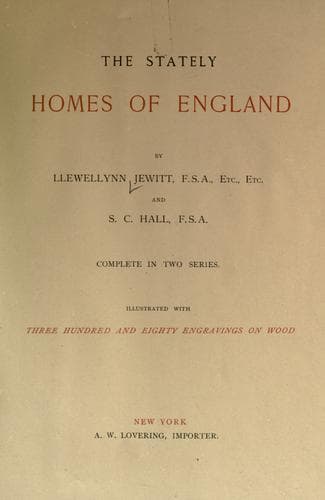
The Stately Homes of EnglandJewitt, Llewellynn Frederick William
History
The Stately Homes of England
Jewitt, Llewellynn Frederick William
Historic buildings -- England
In 1687, William Cavendish, third Earl of Devonshire, who was
afterwards created Duke of Devonshire, after making considerable
alterations in the gardens and grounds, commenced rebuilding the
house. The first part commenced was the south front, which appears
to have been begun to be rebuilt on the 12th of April, 1687, under
the direction of William Talman, the architect. The east side next
followed; the great hall and staircase being covered in, in April,
1690. In 1692 Sir Christopher Wren came down and surveyed the works, at
which time it appears that about £9,000 had been expended. In 1693 the
east front and the north-east corner were commenced, Talman receiving
£600 in advance for the work. In 1700 the east front appears to have
been completed, and about the same time the principal, or west, front
of the old mansion was taken down, and the rebuilding completed in
1706. In 1703 the old south gallery was demolished and rebuilt, and
in 1704 the north front was removed, and the building of the new one
to take its place commenced. The whole edifice appears to have been
finished in 1706, but its noble owner, whose munificence and taste
reared the magnificent pile, did not long live to enjoy its beauties,
for he died in the following year, 1707. Dr. White Kennett, Bishop of
Peterborough, who preached the funeral sermon of this nobleman, wrote
at the time some account of the Cavendish family, in the course of
which he introduced some highly interesting particulars relating to
the mansion and grounds, remarking that “tho’ such a vast pile (of
materials entirely new) required a prodigious expense, yet the building
was the least charge, if regard be had to his gardens, water-works,
pictures, and other of the finest pieces of Art and Nature that could
be obtained abroad or at home.”
The Duke seems to have determined to erect a true Palace of Art, and
for that purpose he employed the best artists of the time in its
decoration. Among the painters employed to decorate the ceilings
and walls of the various rooms with the creations of their genius,
were Verrio, Laguerre, Sir James Thornhill, Ricard, Highmore
(sergeant-painter to William III.), Price, and Huyd. The carvers in
stone and wood, whose names appear in the accounts, were Caius Gabriel
Cibber, Samuel Watson, Henry Watson his son, Mons. Nadauld, J. T.
Geeraerslius, Augustine Harris, Nost, William Davies, M. Auriol, Joel
Lobb, and Lanscroon. The principal iron-worker appears to have been
Mons. Tijou, a French smith, whose daughter was wife of Laguerre the
painter; and the lead-worker, who did the regular plumber’s work, as
well as the lead-piping of the willow-tree, and other water-works under
the guidance of Mons. Grillet, was a Mr. Cock, of London, whose bill
came to about £1,000.
Public-domain text, read in full here on John Shaqi.
Reviews
Reviews
No reviews yet
Be the first to share your thoughts on this work.
Elsewhere in the archive
Join the Discussion
Join the discussion
Sign in to leave a comment or review.
Sign InorCreate an account