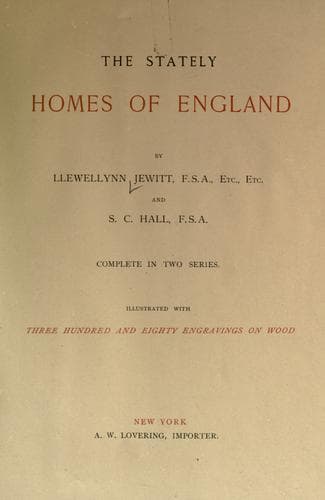
The Stately Homes of EnglandJewitt, Llewellynn Frederick William
History
The Stately Homes of England
Jewitt, Llewellynn Frederick William
Historic buildings -- England
In 1820 the late Duke—William Spencer Cavendish, sixth Duke of
Devonshire—who had succeeded to the title in 1811, commenced some
great improvements at Chatsworth by erecting, from the designs of
Sir Jeffrey Wyatt, the north wing, containing, with all the domestic
offices, a number of other apartments, as well as the dining-room,
sculpture-gallery, orangery, banqueting-room, and pavilion; and by
altering and re-arranging several other rooms. The grounds and gardens,
also, were by this gifted nobleman, very materially remodelled and
improved under the direction of his head-gardener, the late Sir Joseph
Paxton, to whose labours, including the erection of the gigantic
conservatory, the forming of the artificial rocks, &c., we shall have
to refer.
[Illustration: _Chatsworth from the River Derwent._]
Having now traced so far as is necessary for our present purpose the
history of Chatsworth, we proceed to speak of the noble and historical
family of Cavendish, its princely owners. This, however, we shall do
but briefly; having already, in our account of Hardwick Hall, gone into
the family history at some length.
The family of Cavendish, to whose noble head Chatsworth belongs, traces
back to the Conquest, when Robert de Gernon, who came over with the
Conqueror, was rewarded by him for his services with large grants of
lands in Hertfordshire, Gloucestershire, &c. His descendants held
considerable land in Derbyshire; and Sir William Gernon, _temp._ Henry
III., had two sons, Sir Ralph de Gernon, lord of Bakewell, and Geoffrey
de Gernon, of Moor Hall, near Bakewell. From the second of these,
Geoffrey de Gernon, the Cavendishes are descended; his son, Roger de
Gernon (who died in 1334), having married the heiress of the lord of
the manor of Cavendish, in Suffolk; and by her had issue four sons, who
all assumed the name of Cavendish from that manor. These sons were Sir
John Cavendish, Chief Justice of the King’s Bench; Roger Cavendish,
from whom descended the celebrated navigator, Sir Thomas Cavendish;
Stephen Cavendish, Lord Mayor of London; and Richard Cavendish. Sir
John married Alice Odyngseles, who brought to her husband the manor of
Cavendish Overhall; and their eldest son, Sir Andrew Cavendish, left
issue, one son, William, from whom the estates passed to his cousin.
Sir Andrew was succeeded by his brother, Sir John Cavendish, who, for
his gallant conduct in killing the rebel, Wat Tyler, was knighted
by the king; he married Joan, daughter to Sir William Clopton, and
was succeeded by his eldest son, William, a citizen and mercer of
London, who married Joan Staventon, by whom he had issue two sons, the
eldest of whom, Thomas, succeeded him; and whose son and heir, Sir
Thomas Cavendish, Clerk of the Pipe, &c., married twice, and left by
his first wife three sons, George Cavendish, who wrote the “Life of
Cardinal Wolsey,” Sir William Cavendish, and Sir Thomas Cavendish. The
second of these sons, Sir William Cavendish, became the founder of the
Public-domain text, read in full here on John Shaqi.
Reviews
Reviews
No reviews yet
Be the first to share your thoughts on this work.
Elsewhere in the archive
Join the Discussion
Join the discussion
Sign in to leave a comment or review.
Sign InorCreate an account