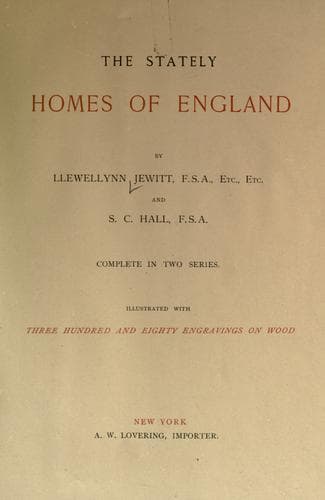
The Stately Homes of EnglandJewitt, Llewellynn Frederick William
History
The Stately Homes of England
Jewitt, Llewellynn Frederick William
Historic buildings -- England
In 1831, Mr. Paxton, in conjunction with Mr. Harrison, commenced the
publication of “The Horticultural Register.” Other works followed,
including his “Magazine of Botany,” a “Practical Treatise on the
Culture of the Dahlia,” a “Pocket Botanical Dictionary,” the “Flower
Garden,” and others, and these will undoubtedly remain standard works.
During the whole of this time, and to the time of the death of the
duke, Mr. Paxton’s mind was actively engaged, and his energy constantly
employed, in the improvement of the gardens and grounds at Chatsworth,
and the erection of the grand conservatory and other plant-houses,
&c. In 1851 he brought his talents to bear in a national matter—the
designing and erecting of the Great Exhibition building of that year,
taking as his model the conservatory which, on his own design in every
particular, he had a few years before erected. In the same year he
was knighted by the Queen, at Windsor, on the 23rd of October, and
in 1854 was elected M.P. for the City of Coventry. Sir Joseph Paxton
designed the present Crystal Palace, and it is not too much to say that
to his principle of glass buildings, of a wide span, and glazed on
the ridge-and-furrow principle (invented by him), there is scarcely a
railway-station, conservatory, or large public hall or pavilion, that
does not trace its origin. Sir Joseph died in 1865, and Lady Paxton in
1871.
Of the interior of the VICTORIA REGIA HOUSE we give an engraving,
showing the gigantic leaf and flower of this royal plant, which was
first grown, and first flowered, at Chatsworth, and named after our
beloved Queen, to whom the first flower was presented in 1849. Besides
the “Victoria Regia House,” other points of interest in the kitchen
gardens are the “New Holland House,” the “Amherstia House,” the “Pine
Houses” and the “Vineries.” The kitchen gardens are not, of course,
open to visitors.
The village of EDENSOR, closely adjoining the park, was, with the
exception of the church and one or two houses, removed to its present
position from its former site in the park some forty years ago. It
is, indeed, the most perfect model village we have ever seen, and the
beauty of its villas—for every cottage in the place _is_ a villa—the
charm of its scenery, and the peace and quietness which seem to
reign in and around it, make it as near an _Eden_ on earth as one
can expect any place to be, and to which its name most curiously and
appropriately points. Edensor is entered by a very picturesque lodge
from the park, and the outlet at its upper extremity is also closed by
gates, so that the only thoroughfare through the place is a highway
to Bakewell. Besides the Agent’s house, there are in Edensor a good
parsonage house and a village school, but, luckily, there is neither a
village ale-house, blacksmith’s forge, wheelwright’s shop, or any other
gossiping place; and unpleasant sights and discordant sounds are alike
unknown.
[Illustration: _The Victoria Regia._]
Public-domain text, read in full here on John Shaqi.
Reviews
Reviews
No reviews yet
Be the first to share your thoughts on this work.
Elsewhere in the archive
Join the Discussion
Join the discussion
Sign in to leave a comment or review.
Sign InorCreate an account