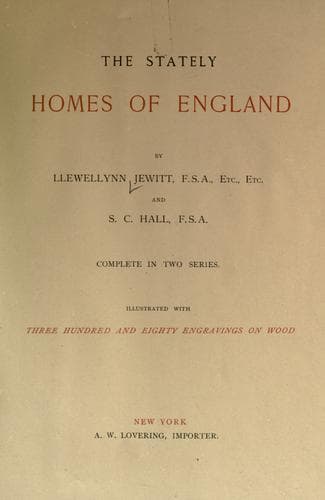
The Stately Homes of EnglandJewitt, Llewellynn Frederick William
History
The Stately Homes of England
Jewitt, Llewellynn Frederick William
Historic buildings -- England
The old church of Edensor was taken down a few years ago, and the
present one, from the design of Gilbert Scott, erected on its site by
his grace the present Duke of Devonshire. The old church consisted
of a nave with side aisles and a chancel, and it had a square
battlemented tower at its west end. The nave and western porch were
also battlemented; the battlements being carried over the gable of the
chancel-arch, in the centre of which was a niche for a sanctus-bell.
The east window was of decorative character, as were those at the east
end of the south aisle, and one near the priests’ door on the south
side of the chancel. Interiorly the church possessed many interesting
features, including some remarkable capitals, which have mostly been
preserved, with the curious monuments, in the new edifice.
[Illustration: _Edensor Church and Village._]
The present church, completed in 1870, is a remarkably fine and elegant
structure, with a lofty tower and broach spire at its west end; of it
we give an engraving, as seen from the upper part of the village, from
a photograph by Mr. E. F. Bampton, of Edensor. It consists of a nave
with side aisles, a chancel, and a monumental chapel opening from the
south side of the chancel. The font, which is of marble, and extremely
chaste and beautiful, is at the west end, and the pulpit, which also
is of marble, is placed against the chancel-arch. In the chancel are
very elegant _sedilia_, and the floor is laid with encaustic tiles.
One of the most historically interesting remains in this church is a
brass plate in the chancel to the memory of John Beton, one of the
household and confidential servants of Mary Queen of Scots, who died at
Chatsworth while his royal mistress was a captive there, in 1570. At
the head of the plate are the arms of Beton (who was of the same family
as Cardinal David Beton, who took so prominent a part in the affairs
of Scotland in the reign of James V. and of Mary, and of James Beton,
Archbishop of St. Andrew’s), quarterly first and fourth a fesse between
three mascles; second and third, on a chevron an otter’s head, erased;
with the crest a talbot’s head. At the bottom is a figure of Beton,
in plate armour, lying dead upon a pallet, his hands by his side and
his head resting on a pillow. Of this historically interesting brass
we give a careful engraving on the opposite page. For this, with some
other illustrations, we are indebted to “The Reliquary, Archæological
Journal.”
Another brass plate, near the chancel-arch, bears the following
inscription:—
Public-domain text, read in full here on John Shaqi.
Reviews
Reviews
No reviews yet
Be the first to share your thoughts on this work.
Elsewhere in the archive
Join the Discussion
Join the discussion
Sign in to leave a comment or review.
Sign InorCreate an account