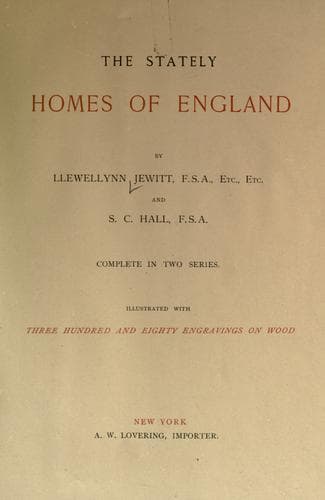
The Stately Homes of EnglandJewitt, Llewellynn Frederick William
History
The Stately Homes of England
Jewitt, Llewellynn Frederick William
Historic buildings -- England
In the windows are the royal arms, the arms and impalements of
Edgcumbe, Cothele, Holland, Tremaine, Trenchard, Durnford, Rame,
Cotterell, Raleigh (for Sir Walter Raleigh’s grandmother was Elizabeth,
daughter of Sir Richard Edgcumbe of Cothele), Trevanion (Sir William
Trevanion married another daughter of Sir Richard Edgcumbe, and fought
by his side at Bosworth Field, and accompanied him in his pursuit of
the mutual enemy, Sir Henry Bodrugan), Carew, of Anthony (of the family
of Carew the historian), St. Maur, Courtenay, Bigbury, Fitzwalter, &c.
The dining-room is a charming tapestried apartment, with mullioned
windows and a fine old fire-place. The tapestry is highly interesting,
one of the subjects being the story of Eurydice, another Diana and
Apollo, and the others rural scenes, equestrian figures, &c.
Adjoining the dining-room is an ante-room of surpassing interest. “The
tapestry in this room represents the Sciences, and might be called the
school of Athens, from the similarity of the subject to the celebrated
picture of Raphael.” In this room, as in others, has been collected
together a fine assemblage of old earthenware and other interesting
matters relating to the life of the inmates in times of old.
The chapel, which is in the corner of the court-yard, contains a pretty
open-work oak screen, and an arched roof at the intersections of
which are carved bosses. The bowl of the original font is preserved.
In the east window, in stained glass, are considerable portions of
full-length figures, probably of saints, but the names do not appear,
while in the upper light is represented the Annunciation. The angel is
red with green wings, and on a label, in black letter, the words “Ave
Maria gracia plena, D̄ns tecum.” The Virgin is on the other side, near
a building resembling a church, with a label also, on which once was
“Ecce ancilla D̄ni; fiat ̄mi s̄cdm verbū-tuū.” In the lower compartment
of the window will be noticed three shields of arms: the first being
Edgcumbe, quartering Tremaine (or Trenchard); the second, first, and
fourth Edgcumbe, second Holland, third Tremaine, impaling first and
fourth Durnford, second Fitzwalter, and third, now blank but probably
originally containing Bigbury; and the third which contained Edgcumbe
and several quarterings, much injured. In the south window are two
female saints, St. Ann and St. Katherine. “An ancient altar-piece has
the date 1589, and in the centre the adoration of the Magi; while on
one door is the portrait of a man with ‘æt suæ 38,’ and on the other
of a female, with ‘æt suæ 28,’ and on each door a shield with _or_, an
arrow, _sable_.” The chapel is entered from the dining-room as well as
from the court-yard and domestic offices. It has a small bell turret.
Public-domain text, read in full here on John Shaqi.
Reviews
Reviews
No reviews yet
Be the first to share your thoughts on this work.
Elsewhere in the archive
Join the Discussion
Join the discussion
Sign in to leave a comment or review.
Sign InorCreate an account