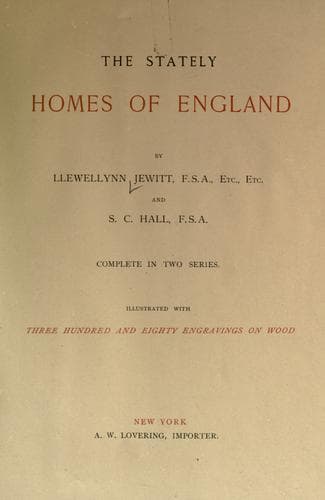
The Stately Homes of EnglandJewitt, Llewellynn Frederick William
History
The Stately Homes of England
Jewitt, Llewellynn Frederick William
Historic buildings -- England
The bed-rooms—“the white room,” the “red room,” the “best room,”
“King Charles’s room,” and “Queen Anne’s room”—are all hung with fine
tapestry, and furnished in a style strictly in keeping with the place
itself. The ceiling of the first of these is of geometric design. The
carved furniture in these rooms is of the most interesting character,
and among the decorations are many shields of arms of the Edgcumbes and
their alliances. The tapestry is of the finest character, the furniture
grand as old furniture well can be, the hangings rich in material
and hoary with age, and the ornaments of the most veritable _vertu_
character—each room in this grand old mansion offers subject-matter
enough for a separate volume.
[Illustration: _The Mansion._]
The drawing-room is also a fine tapestried apartment, furnished with
massive ebony chairs, ebony sofa, and ebony carved cabinet, and all
the appliances _en suite_. The kitchen and the other domestic offices
are each and all of the most interesting character, and convey to the
mind a vivid picture of the life of the inmates in days gone by. It
is impossible, indeed, to conceive anything better than Cothele as
an illustration of the home-life of our mediæval ancestors; for the
building, the furniture, and the appliances, as they are to-day, so
were they three hundred years ago. As it was in the days of Henry VII.,
so it is in those of Queen Victoria; and so, thanks to the preserving
spirit of the Edgcumbes, it is likely to remain for centuries to come.
On some of the previous pages mention is made of Sir Richard Edgcumbe’s
escape from his pursuers, and of his founding a chapel on the spot of
his deliverance. This little chapel still stands to mark the spot,
and to bring back to the mind the circumstances of his escape, and of
the discomfiture of his pursuers. The chapel is built on the edge of
the rock overlooking the water, and from the east window the view is
wonderfully grand. In this east window is a figure of St. George in the
centre, with the Annunciation and the Crucifixion on either side. It
also bears the arms of Edgcumbe and Tremaine. In the other windows are
also figures in stained glass, and on the altar is a triptych. Among
other interesting features in this chapel—and they are many—is a
fac-simile of the ancient tomb of Sir Richard Edgcumbe, at Morlaix.
Public-domain text, read in full here on John Shaqi.
Reviews
Reviews
No reviews yet
Be the first to share your thoughts on this work.
Elsewhere in the archive
Join the Discussion
Join the discussion
Sign in to leave a comment or review.
Sign InorCreate an account