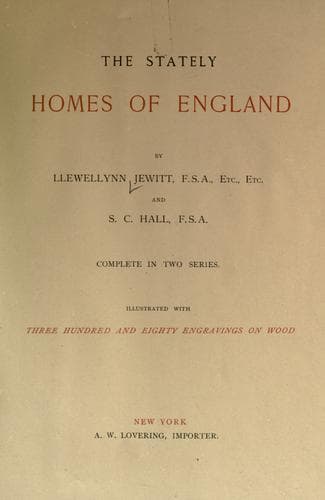
The Stately Homes of EnglandJewitt, Llewellynn Frederick William
History
The Stately Homes of England
Jewitt, Llewellynn Frederick William
Historic buildings -- England
The road continues by Tansley, with its church, its mills, and its
pretty dales; Tansley, or Dethick, Moor, a wild unreclaimed tract of
moorland, purple with heather and untrammelled with fences; Washington,
with its village-green, its stocks, and its duck-ponds; Higham, a
picturesque village with an ancient cross; Shirland, with its fine
monuments, some of which are of remarkable character and full of
interest; Morton, with its pretty church and charming cottages; for
a short distance the coal district, with their pits and shafts and
ever-creaking engines; Pilsley and its pleasant lanes; Hardstoft and
Deeplane, to the lower entrance to the Park: through these and other
places of deep and varied interest we go, until we reach the Hardwick
Inn—a pretty house of entertainment close to the entrance to the
Park, from which a winding ascent of less than a mile leads to the
Hall. By this route some curious transitions from the lead-mining
district to that of coal, and from the limestone to the sandstone,
with their varied scenery and their diversified aspects, will be
noticed; and Derbyshire, rich both in minerals beneath the surface and
in arable, meadow, and pasture land on its face, as well as in rock,
and tree, and wood, and hill, will be seen to great advantage. From
Chesterfield, too, the road is beautiful; and the visitor may make a
delightful “day’s round” by driving direct to Hardwick by way of Temple
Normanton; Heath, with its truly picturesque and interesting church and
parsonage; Ault Hucknall, in the church of which are many monuments
of the Cavendish family, and where lies buried that sometime “world’s
wonder,” “Hobbes of Malmesbury;” thence through the lodge-gates and
down the fine old deer-park to the Hall, and then returning by way of
Bolsover Castle, a magnificent old building, the former residence of
the Cavendishes, Earls and Dukes of Newcastle, and rendered famous in
the Duke of Newcastle’s work on horsemanship, 1658, and now for many
years the residence of Mrs. Hamilton Gray, the authoress of “Etruria.”
But from whatever side Hardwick is approached, the land is full of
beauty, and rich in the picturesque.
Hardwick Hall is one of the many princely seats—Chatsworth, Bolton
Abbey, Lismore Castle, Holker Hall, Compton Place, Eastbourne, and
Devonshire House, London, being among the others—of his Grace the
Duke of Devonshire, in which resides the duke’s eldest son and heir,
the Marquis of Hartington, M.P., at this time Her Majesty’s Secretary
of State for Ireland. It is distant from London about 140 miles,
from Derby 20 miles, from Chesterfield 9, and from Matlock 15 miles,
and these are perhaps the more general routes by which visitors will
proceed. Whatever road is taken, they will find natural beauties in
abundance greeting the eye at every mile of a delicious journey.
Before we describe the venerable Hall, we give a brief history of
the noble family to which it now belongs, reserving that of its
predecessors for a later page.
Public-domain text, read in full here on John Shaqi.
Reviews
Reviews
No reviews yet
Be the first to share your thoughts on this work.
Elsewhere in the archive
Join the Discussion
Join the discussion
Sign in to leave a comment or review.
Sign InorCreate an account