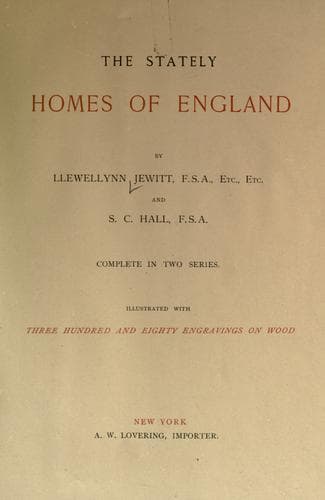
The Stately Homes of EnglandJewitt, Llewellynn Frederick William
History
The Stately Homes of England
Jewitt, Llewellynn Frederick William
Historic buildings -- England
The family of Cavendish, of which his Grace the present Duke of
Devonshire, K.G., Lord Lieutenant of the county of Derby, is the
representative, traces back to the Conquest, when Robert de Gernon came
over with the Conqueror, and so distinguished himself in arms that
he was rewarded with considerable grants of land in Hertfordshire,
Gloucestershire, &c. His descendants held considerable land in
Derbyshire; and Sir William Gernon, who was one of the witnesses to
a confirmation charter of Henry III. to Basingdale Priory, obtained
a grant of a fair at Bakewell, in that county. He had two sons, Sir
Ralph de Gernon, lord of Bakewell, and Geoffrey de Gernon, of Moor
Hall, near Bakewell. From the second of these, Geoffrey de Gernon, the
Cavendishes are descended. His son, Roger de Gernon (who died 1334),
married the heiress of John Potton, or Potkins, Lord of the Manor
of Cavendish, in Suffolk, and by her had issue, four sons, who all
assumed the name of Cavendish from their mother’s manor. These were
Sir John Cavendish, Chief Justice of the King’s Bench, in the time
of Edward III., Chancellor of Cambridge, 4th of Richard II.; he was
beheaded by the insurgents of Suffolk in that reign; Roger Cavendish,
from whom descended the celebrated navigator, Sir Thomas Cavendish;
Stephen Cavendish, Lord Mayor, member of Parliament, and Sheriff of
London; and Richard Cavendish. Sir John married Alice, daughter of Sir
John Odyngseles, Chief Justice of the King’s Bench, who brought to her
husband the manor of Cavendish Overhall, and by her, who died before
him, had issue, two sons, Andrew and John, and a daughter, Alice,
married to William Nell. Sir Andrew Cavendish, the eldest son, was
Sheriff of Norfolk and Suffolk. By his wife, Rose, he left issue, one
son, William, from whom the estates passed to his cousin. Sir Andrew
was succeeded by his brother, Sir John Cavendish, Esquire of the Body
to Richard II. and Henry V., who, for his gallant conduct in killing
the rebel, Wat Tyler, in his conflict with Sir William Walworth, was
knighted by Richard II. in Smithfield, and an annuity of £40 per annum
granted to him and his sons for ever. He was also made broiderer of
the wardrobe to the king. He married Joan, daughter of Sir William
Clopton, of Clopton, in Suffolk; and by her had issue, three sons,
William, his successor; Robert, Serjeant-at-Law; and Walter. William
Cavendish, who was a citizen and mercer of London, and of Cavendish
Overhall, married Joan Staventon, by whom he had two sons, Thomas and
William. This Thomas Cavendish, who was of Cavendish and Pollingford,
in Suffolk, married Katherine Scudamore, and left by her, as son and
heir, Sir Thomas Cavendish, who, having studied the law, was employed
by Thomas, Earl of Surrey, Treasurer of the King’s Exchequer. He was
also Clerk of the Pipe in the Exchequer to Henry VIII.—the office of
the Clerk of the Pipe being to make out leases of Crown lands, accounts
of the sheriffs, &c.
Public-domain text, read in full here on John Shaqi.
Reviews
Reviews
No reviews yet
Be the first to share your thoughts on this work.
Elsewhere in the archive
Join the Discussion
Join the discussion
Sign in to leave a comment or review.
Sign InorCreate an account