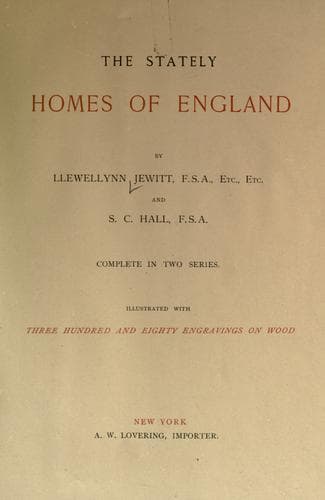
The Stately Homes of EnglandJewitt, Llewellynn Frederick William
History
The Stately Homes of England
Jewitt, Llewellynn Frederick William
Historic buildings -- England
He married twice, and left, by his first wife,
Alice, daughter and co-heir of John Smith, of Podbrooke Hall, besides
other issue, three sons, George Cavendish, Sir William Cavendish, and
Sir Thomas Cavendish.
George Cavendish, the eldest of these three sons, was of Glemsford,
and Cavendish Overhall, and is said to have been the author of
“Cavendish’s Life of Wolsey,” although the authorship of that work
is also attributed to his brother Sir William Cavendish. He received
a liberal education, and was endowed by his father with considerable
landed property in Suffolk. His character and learning seem to have
recommended him to the special notice of Cardinal Wolsey, who “took
him to be about his own person, as gentleman usher of his chamber, and
placed a special confidence in him.” George Cavendish was succeeded
by his son William; the latter was succeeded by his son William, who
passed away the manor of Cavendish Overhall to William Downes.
Sir Thomas Cavendish was one of the Knights of St. John of Jerusalem,
and died unmarried.
Sir William Cavendish, the second son of the first Sir Thomas, became
the founder of several noble families. He was married three times:
first to a daughter of Edward Bostock, of Whatcross in Cheshire;
secondly, to a daughter of Sir Thomas Conyngsby, and widow of William
Paris; and thirdly, to Elizabeth, daughter of John Hardwick, of
Hardwick, and widow of Robert Barley, of Barley. He was “a man of
learning and business,” and was much employed in important affairs by
his sovereigns; filling the posts of Treasurer of the Chamber and Privy
Councillor to Henry VIII., Edward VI., and Mary. At the suppression
of the religious houses under Henry VIII., he was “appointed one of
the Commissioners for visiting them, and afterwards was made one of
the auditors of the Court of Augmentation,” which was instituted
for the purpose of augmenting the revenues by the suppression of
the monasteries; for his services he received three valuable manors
in Hertfordshire which, later on, he exchanged for other lands, in
Derbyshire and other counties. He was also knighted by Henry VIII. By
his first wife he had issue, one son and two daughters who died young,
and two other daughters, one of whom, Catherine, married Sir Thomas
Brooke, son of Lord Cobham, and Anne, who married Sir Henry Baynton.
By his second wife he had three daughters, who all died young, and
she herself died in child-birth. By his third marriage, with “Bess
of Hardwick,” he had a numerous family, viz.:—Henry Cavendish, of
Tutbury, Member of Parliament for Derbyshire, who married Grace,
daughter of George, Earl of Shrewsbury, but died without lawful issue;
Sir William Cavendish, created Earl of Devonshire, of whom hereafter;
Sir Charles Cavendish, of Bolsover Castle and of Welbeck Abbey (whose
son, William Cavendish, by his first wife, was created Duke, Marquis,
and Earl of Newcastle, Baron Ogle, Baron Cavendish, of Bolsover,
Public-domain text, read in full here on John Shaqi.
Reviews
Reviews
No reviews yet
Be the first to share your thoughts on this work.
Elsewhere in the archive
Join the Discussion
Join the discussion
Sign in to leave a comment or review.
Sign InorCreate an account