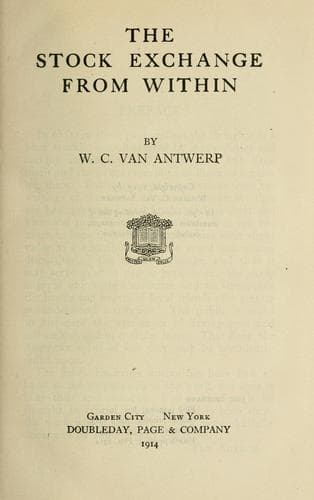
The Stock Exchange from WithinVan Antwerp, William C. (William Clarkson)
History
The Stock Exchange from Within
Van Antwerp, William C. (William Clarkson)
New York Stock Exchange; Stock exchanges
When you buy a house even if both parties sign, the agreement is
worthless unless you put up one American dollar and get the other
fellow’s receipt for it in writing. If you buy a horse or a cow, or
anything else of value, the same precaution is necessary. So too if
you sign a will. Your own word is not good enough. You must get two
others to sign with you before the Surrogate is satisfied.
None of this in the Stock Exchange. A wink, or two fingers held up,
is enough. Often in the thick of the fight when the floor of the
Exchange is a howling mob, when frenzied brokers shout themselves
hoarse and stocks are going up and down by leaps and bounds, and
ruin or fortune is measured by minutes, the lifting of a man’s hand
over the heads of the crowd is all that binds the bargain.
What may have happened in the half hour’s interim, before the
buyer and seller can compare and confirm, makes no difference in
the bargain. It may be ruin--possibly is--to one or the other,
but there is no crawling--no equivocation--no saying you didn’t
understand, or “I was waving to the man behind you.” Just this
plain, straight, unvarnished truth, “Yes, that’s right--send it in.”
If it be ruin, the loser empties out on the table everything he
has in his pockets; everything he has in his bank; all his houses,
lots, and securities--often his wife’s jewels, and pays 30, 40, or
70 per cent., as the case may be.
What he has saved from the wreck are his integrity and his good
name. In this salvage lies the respect with which his fellows hold
him.
Every hand is now held out. He has stood the test, he has made
good. Let him have swerved by a hair’s breadth and his career in
the Street would have been ended.[98]
Of course mistakes and misunderstandings do sometimes occur, and these
are the banes of the broker’s life. He will lose $500 with equanimity
on a personal venture, but he will howl in distress over a loss of
$25 on a mistake, and apply to himself a lurid mosaic of epithets
because of it. The one merely shows bad judgment and is one of the
little amenities; the other he feels is stupidity. At such times the
stockbroker adopts Talleyrand’s bold hyperbole when he heard of the
death of the Duc d’Enghien, “It is worse than a crime; it is a blunder.”
Public-domain text, read in full here on John Shaqi.
Reviews
Reviews
No reviews yet
Be the first to share your thoughts on this work.
Elsewhere in the archive
Join the Discussion
Join the discussion
Sign in to leave a comment or review.
Sign InorCreate an account