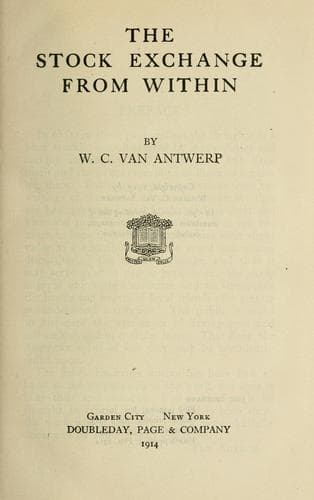
The Stock Exchange from WithinVan Antwerp, William C. (William Clarkson)
History
The Stock Exchange from Within
Van Antwerp, William C. (William Clarkson)
New York Stock Exchange; Stock exchanges
As a matter of fact, failures of brokerage houses are peculiarly
abhorrent to every one concerned. In the Paris Bourse a broker must
give security at $50,000, and his bankruptcy in all cases is considered
a fraudulent one, rendering him liable to arrest. The French _Agents
de Change_ enjoy an absolute government monopoly, and naturally in
the circumstances they are held to the strictest accountability; but
aside from that a tendency is plainly discernible nowadays in all large
financial centres to demand of stockbrokers on the Exchange a rigid
adherence to such business methods as will prevent bankruptcies of
dealers to whom the public entrusts its money.
The danger of the London fortnightly settlement system lies not in the
deferred delivery of securities, but in the fortnightly settlement of
“differences.” A London broker may be actually bankrupt, yet if he is
desperate or unscrupulous, knowing that his differences will not have
to be settled for a fortnight, he may plunge into speculative risks
fraught with the utmost danger. If the market goes his way he is saved;
if it goes against him, he is still no more than bankrupt. But in his
fall, as a result of this dishonest venture, he may conceivably ruin
many others, and a chain of disasters may follow his excesses. It
should be said in this connection that London jobbers and brokers keep
a sharp watch on each other; it is extraordinary how quickly the news
gets about if this man or that is over-extended. Again, either broker
or jobber may discriminate in his dealings, taking care to avoid those
against whom there is a suspicion.
Notwithstanding the points of merit in the New York system, at some
time in the future when local Stock Exchange business has expanded to
proportions approaching those of the London Exchange, modifications
must be made. If banks and brokerage houses are given a week or ten
days to settle transactions, everybody will have a tolerably clear
idea of what money will be required, and lenders will be enabled to
make provision. London passed through the 1907 panic, under this
arrangement, with a maximum rate of 7 per cent., while we in New York
would have been glad to pay 200 per cent., and this, despite our
deplorable currency system, could not have occurred had there been
ample time for the banks to make preparations.
From these observations it may be suggested that perhaps the time
will come when the governors of the New York Stock Exchange may find
it necessary to put in force a combination of daily settlement of
differences, such as we have at present, with a periodical delivery
of stock such as they have in London. Transactions for cash need not
be affected by this arrangement, nor would the public lose any of the
protection it now enjoys. In any case, if such a plan resulted in
minimizing those violent fluctuations in our call-money market which
have so long afflicted us, it would prove a permanent blessing.
Public-domain text, read in full here on John Shaqi.
Reviews
Reviews
No reviews yet
Be the first to share your thoughts on this work.
Elsewhere in the archive
Join the Discussion
Join the discussion
Sign in to leave a comment or review.
Sign InorCreate an account