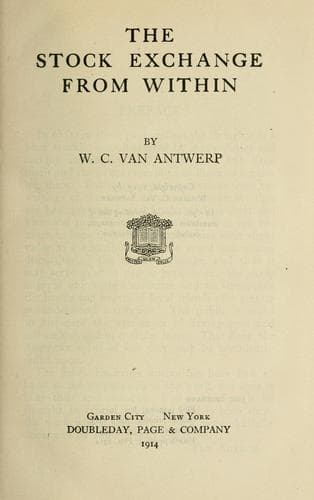
The Stock Exchange from WithinVan Antwerp, William C. (William Clarkson)
History
The Stock Exchange from Within
Van Antwerp, William C. (William Clarkson)
New York Stock Exchange; Stock exchanges
As there is no currency system anywhere in the civilized world so crude
and inadequate as that of the United States, it is unnecessary to say
that London jobbers and brokers experience none of the difficulties
with money markets that occur periodically on this side. The carry-over
on the other side of the water is frequently a matter involving immense
sums of money, but rates fluctuate normally and are in large measures
governed by automatic processes both simple and sane. Perhaps the less
said about similar conditions here the better. The spectacle presented
by strong and solvent houses ransacking the street for funds secured
by prime collateral and bidding 25, 50, and even 100 per cent. for
accommodation--something that has occurred within the last decade and
may conceivably occur again--is one upon which the candid American
observer does not care to dwell; such a man may well look with longing
and envy to London, where capital, credit, and currency are so firmly
established that the Bank of England dominates and controls all the
money markets and gold movements of the world, lending freely at home
and abroad whenever funds are needed, and acting as a civilizing
force in supplying with British funds the commercial needs of all new
countries.
In this connection we may point out the method of borrowing from the
banks the funds required to carry speculative commitments in London. It
was formerly the practice for the banks to lend large sums to brokers,
who employed the money inside the house in carrying over the accounts
of their clients. This class of business is still large, but nowadays
clients are not always satisfied to borrow through brokers, and not
infrequently they go direct to the banks and borrow from them. This has
the effect of disguising the real character of the business. To all
appearances the securities have been bought and paid for, and the trade
seems to be an investment, but the client has, as a matter of fact,
“pawned” the security with a bank.
This practice is inconvenient in a way, because where the jobbers
in important markets formerly compared notes at each settlement and
were thus enabled to form a pretty good idea of the condition of the
speculative account, it is less easy to do so nowadays, when so many
clients carry on their own borrowing. A similar tendency on the part
of the public is noticeable in New York, although, of course, the
daily settlement on this side obviates the necessity for arriving at
conclusions in advance as to the requirements of funds.
Public-domain text, read in full here on John Shaqi.
Reviews
Reviews
No reviews yet
Be the first to share your thoughts on this work.
Elsewhere in the archive
Join the Discussion
Join the discussion
Sign in to leave a comment or review.
Sign InorCreate an account