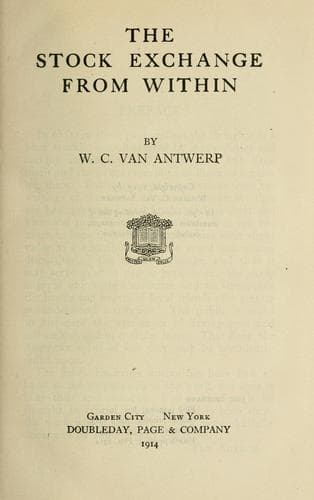
The Stock Exchange from WithinVan Antwerp, William C. (William Clarkson)
History
The Stock Exchange from Within
Van Antwerp, William C. (William Clarkson)
New York Stock Exchange; Stock exchanges
Now speculation is an all-embracing word, overworked, threadbare,
and worn to the bone. Originally it meant “to see”; then “to view,”
“watch,” “spy out”; then “exploration” or “contemplation.” When thrift
came into the language and men ceased burying their gold, it began to
take on a new meaning. The spirit of legitimate adventure, that entered
men’s minds when the Most Christian Kings abandoned brute force and
repudiation, led men to buy things in the hope of selling them at a
profit. It was risky business at first, and capital, then as now, was
timid. The High Finance of the Middle Ages was not easily forgotten.
But little by little channels through which enterprise might flow into
wealth came into being, and confidence came with them. This was called
speculation.
By the time Adam Smith wrote his “Wealth of Nations” (1776) the word
was firmly fixed in the language. “The establishment of any new
manufacture,” he said, “or any new branch of commerce, or of any
new practice in agriculture, is always a speculation from which the
projector promises himself extraordinary profits.” How the early
channels of speculation broadened into great rivers, how confidence
grew as the art of making money and increasing it developed, how credit
became established, how speculation led to the opening of new countries
and the extension of immense advantages, through civilization, to the
people of those countries--all this is a fascinating story. And yet
the speculation of to-day is no different in its elementals from that
of the early Greeks; the same spirit of “divine unrest” that spurs on
the philosopher in his study stimulates the explorer of strange lands,
beckons on the engineer and the builder of railways, and attracts the
capital of the adventurous investor. We cannot stop it if we would,
because hope, ambition, and avarice are fundamentals of human nature.
The police cannot arrest them; they are fixed and immutable.
If there is more speculation in material things to-day than there ever
was before, it is because there are more things to speculate in, more
money to speculate with, more people to speculate, and more machinery,
like telephones and telegraphs, to facilitate speculation. Capital,
credit, and new undertakings grow day by day and open new avenues of
possible profit. The per capita wealth of nations, growing by what it
feeds on, constantly seeks new fields for enterprise and adventure.
The intelligence of the people increases by leaps and bounds, and goes
peering curiously into all the little nooks and crannies of the world
for opportunities of gain--the apotheosis of speculative enterprise.
Public-domain text, read in full here on John Shaqi.
Reviews
Reviews
No reviews yet
Be the first to share your thoughts on this work.
Join the Discussion
Join the discussion
Sign in to leave a comment or review.
Sign InorCreate an account