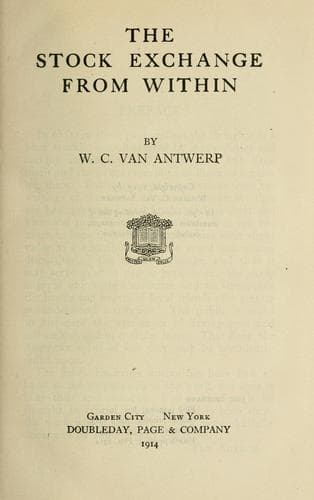
The Stock Exchange from WithinVan Antwerp, William C. (William Clarkson)
History
The Stock Exchange from Within
Van Antwerp, William C. (William Clarkson)
New York Stock Exchange; Stock exchanges
An extraordinary number of small investors bought fractional shares;
the offices of the companies were not prepared for the rush and could
not handle the large carry-over, hence for a time the “Kaffir Circus,”
as the speculative mania of the day was called, promised to embarrass
seriously the whole Exchange machinery. All this could have been
avoided by making the shares “to bearer.” Yet the London authorities
feel--and not without reason when we consider the volume of their
business and the remoteness of their clientele in many instances--that
bearer certificates are not safe, and that what is lost in the time
spent in transferring certificates is amply compensated in the
resultant security against fraud and forgery.
It is interesting to note in connection with the enormous business done
on the London Exchange--a business which makes New York’s high totals
seem insignificant--on what a vast scale London’s exports of capital
are conducted. This may properly be noticed here, since these capital
exports have great economic significance and bear close relationship
to the transactions on the Stock Exchange; indeed were it not for the
work done by the Exchange in providing markets and settlements and all
the details of the security business, it is fair to say there could be
no such public issues of capital. In 1910, for example, new capital
expenditures amounted to the extraordinary figure of £267,439,000, of
which £60,296,500 was expended in the United Kingdom, £92,378,100 in
the various British possessions, and £114,764,500 in foreign countries.
Of the grand total £49,974,000 went into foreign railways, £10,096,000
into Indian and Colonial railways, £35,631,600 into Colonial government
loans, £18,431,000 into foreign government loans, £18,343,100 into
explorations, and £19,143,800 into rubber.[110] The year 1910 was,
of course, a year of great prosperity in England, and it was a year
made famous by speculative activity in various directions, especially
in rubber, so that the totals given above are larger than they had
ever been before. But the point for us in America to bear in mind in
considering these figures is their immense significance as showing
England’s complete supremacy in capital, credit, and the art of banking.
Public-domain text, read in full here on John Shaqi.
Reviews
Reviews
No reviews yet
Be the first to share your thoughts on this work.
Elsewhere in the archive
Join the Discussion
Join the discussion
Sign in to leave a comment or review.
Sign InorCreate an account