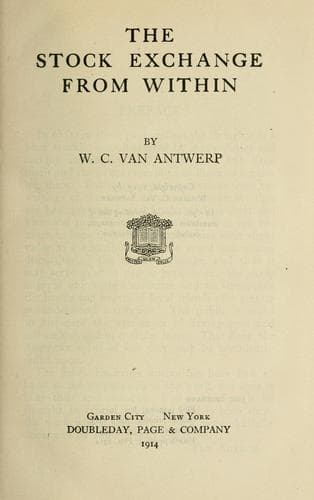
The Stock Exchange from WithinVan Antwerp, William C. (William Clarkson)
History
The Stock Exchange from Within
Van Antwerp, William C. (William Clarkson)
New York Stock Exchange; Stock exchanges
We have been strongly urged to advise the prohibition or limitation
of short sales, not only on the theory that it is wrong to agree to
sell that what one does not possess, but that such sales reduce the
market price of the securities involved. We do not think that it is
wrong to agree to sell something that one does not now possess, but
expects to obtain later. Contracts and agreements to sell, and deliver
in the future, property which one does not possess at the time of the
contract, are common in all kinds of business. The man who has “sold
short” must some day buy in order to return the stock which he has
borrowed to make the short sale. Short sellings endeavor to select
times when prices seem high in order to sell, and times when prices
seem low in order to buy, their action in both cases serving to lessen
advances and diminish declines of price. In other words, short selling
tends to produce steadiness in prices, which is an advantage to the
community. No other means of restraining unwarranted marking up and
down of prices has been suggested to us.
The legislation of the State of New York on the subject of short
selling is significant. In 1812 the Legislature passed a law declaring
all contracts for the sale of stocks and bonds void, unless the seller
at the time was the actual owner or assignee thereof or authorized by
such owner or assignee to sell the same. In 1858 this act was repealed
by a statute now in force, which reads as follows:
“An agreement for the purchase, sale, transfer, or delivery of a
certificate or other evidence of debt, issued by the United States
or by any State, or municipal or other corporation, or any share
or interest in the stock of any bank, corporation or joint-stock
association, incorporated or organized under the laws of the United
States or of any State, is not void, or voidable, because the
vendor, at the time of making such contract, is not the owner or
possessor of the certificate, or certificates, or other evidence of
debt, share or interest.”
It has been urged that this statute “specifically legalizes stock
gambling.” As a matter of fact, however, the law would be precisely the
same if that statute were repealed, for it is the well-settled common
law of this country, as established by the decisions of the Supreme
Court of the United States and of the State courts, that all contracts,
other than mere wagering contracts, for the future purchase or sale
of securities or commodities are valid, whether the vendor is, or is
not, at the time of making such contract, the owner or possessor of the
securities or commodities involved, in the absence of a statute making
such contracts illegal. So far as any of these transactions are mere
wagering transactions, they are illegal, and not enforceable, as the
law now stands.
Public-domain text, read in full here on John Shaqi.
Reviews
Reviews
No reviews yet
Be the first to share your thoughts on this work.
Elsewhere in the archive
Join the Discussion
Join the discussion
Sign in to leave a comment or review.
Sign InorCreate an account