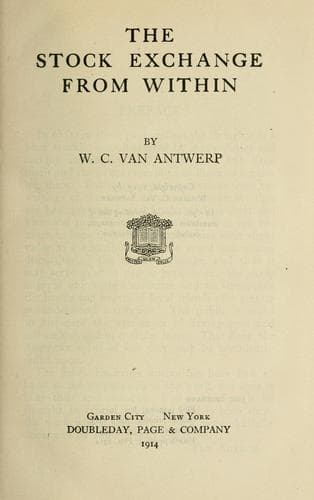
The Stock Exchange from WithinVan Antwerp, William C. (William Clarkson)
History
The Stock Exchange from Within
Van Antwerp, William C. (William Clarkson)
New York Stock Exchange; Stock exchanges
It has been suggested to us that there should be a requirement either
by law or by rule of the Stock Exchange, that no one should sell any
security without identifying it by a number or otherwise. Such a rule
would cause great practical difficulties in the case of securities
not present in New York at the time when the owner desires to sell
them, and would increase the labor and cost of doing business. But
even if this were not the effect, the plan contemplates a restriction
upon short sales, which, for the reasons set forth above, seems to us
undesirable. It is true that this identification plan exists in England
as to sales of bank shares (Leeman act of 1867); but it has proved a
dead letter. It has also been used in times of apprehended panic upon
the French Bourse, but opinions in regard to its effect there are
conflicting. While some contend that it has been useful in preventing
panics, others affirm that it has been used simply for the purpose of
protecting bankers who are loaded down with certain securities which
they were trying to distribute, and who, through political influence,
procured the adoption of the rule for their special benefit.
MANIPULATION OF PRICES
A subject to which we have devoted much time and thought is that of the
manipulation of prices by large interests. This falls into two general
classes:
(1.) That which is resorted to for the purpose of making a market for
issues of new securities.
(2.) That which is designed to serve merely speculative purposes in the
endeavor to make a profit as the result of fluctuations which have been
planned in advance.
The first kind of manipulation has certain advantages, and when not
accompanied by “matched orders” is unobjectionable _per se_. It is
essential to the organization and carrying through of important
enterprises, such as large corporations, that the organizers should be
able to raise the money necessary to complete them. This can be done
only by the sale of securities. Large blocks of securities, such as
are frequently issued by railroad and other companies, cannot be sold
over the counter or directly to the ultimate investor, whose confidence
in them can, as a rule, be only gradually established. They must
therefore, if sold at all, be disposed of to some syndicate, who will
in turn pass them on to middlemen or speculators, until, in the course
of time, they find their way into the boxes of investors. But prudent
investors are not likely to be induced to buy securities which are not
regularly quoted on some exchange, and which they cannot sell, or on
which they cannot borrow money at their pleasure. If the securities
are really good and bids and offers bona fide, open to all sellers and
buyers, the operation is harmless. It is merely a method of bringing
new investments into public notice.
Public-domain text, read in full here on John Shaqi.
Reviews
Reviews
No reviews yet
Be the first to share your thoughts on this work.
Elsewhere in the archive
Join the Discussion
Join the discussion
Sign in to leave a comment or review.
Sign InorCreate an account