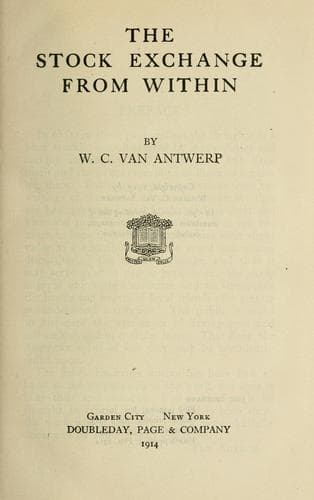
The Stock Exchange from WithinVan Antwerp, William C. (William Clarkson)
History
The Stock Exchange from Within
Van Antwerp, William C. (William Clarkson)
New York Stock Exchange; Stock exchanges
Tickers carrying the quotations should be licensed and bear a plate
whereon should appear the name of the corporation, firm, or individual
furnishing the service or installing the ticker, and a license number.
Telegraph companies buying or transmitting quotations from the
exchanges should be required to publish semi-annually the names of all
subscribers to the service furnished, and the number and location of
the tickers, in a newspaper of general circulation published in the
city or town in which such tickers are installed. In case the service
is furnished to a corporation, firm, or person, in turn supplying the
quotations to others, like particulars should be published. A record,
open to public inspection, should be kept by the installing company
showing the numbers and location of the tickers. Doubtless local boards
of trade, civic societies, and private individuals would, if such
information were within their reach, lend their aid to the authorities
in the enforcement of the law.
Measures should be taken also to control the direct wire service for
the transmission of quotations, and for the prompt discontinuance of
such service in case of improper use thereof. In short, every possible
means should be employed to prevent bucket-shops from obtaining the
continuous quotations, without which their depredations could not be
carried on a single day.
THE COMMODITY EXCHANGES
Of the seven commodity exchanges in the city of New York, three dealing
with Produce, Cotton, and Coffee, are classed as of major importance;
two organized by dealers in Fruit and Hay, are classed as minor; and
two others, the Mercantile (concerned with dairy and poultry products)
and the Metal (concerned with mining products) are somewhat difficult
of classification, as will appear hereafter.
THE MAJOR EXCHANGES
The business transacted on the three major exchanges is mainly
speculative, consisting of purchases and sales for future delivery
either by those who wish to eliminate risks or by those who seek to
profit by fluctuations in the value of products. “Cash” or “spot”
transactions are insignificant in volume.
The objects, as set forth in the charters, are to provide places for
trading, establish equitable trade principles and usages, obtain and
disseminate useful information, adjust controversies, and fix by-laws
and rules for these purposes.
Trading in differences of price and “wash sales” are strictly
prohibited under penalty of expulsion. All contracts of sale call for
delivery, and unless balanced and canceled by equivalent contracts of
purchase, must be finally settled by a delivery of the merchandise
against cash payment of its value as specified in the terms of the
contract; but the actual delivery may be waived by the consent of both
parties. Possession is for the most part transferred from the seller
to the purchaser by warehouse receipts entitling the holder to the
ownership of the goods described.
DEALING IN “FUTURES”
Public-domain text, read in full here on John Shaqi.
Reviews
Reviews
No reviews yet
Be the first to share your thoughts on this work.
Elsewhere in the archive
Join the Discussion
Join the discussion
Sign in to leave a comment or review.
Sign InorCreate an account