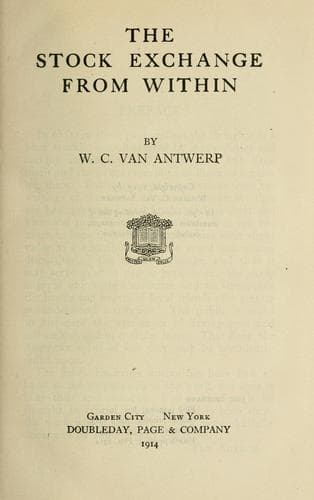
The Stock Exchange from WithinVan Antwerp, William C. (William Clarkson)
History
The Stock Exchange from Within
Van Antwerp, William C. (William Clarkson)
New York Stock Exchange; Stock exchanges
To the trader, manufacturer, or exporter, the act of transferring the
risk of price fluctuations to other persons who are willing to assume
it, has the effect of an insurance. It enables him to use all of his
time and capital in the management of his own business instead of
devoting some part of them to contingencies arising from unforeseen
crop conditions.
ALTERNATIVE CONTRACTS
In order to eliminate the risk of a shortage of specific grades of the
merchandise thus traded in, contracts generally permit the delivery of
alternative grades, within certain limits, at differential prices; and
if the grade to be delivered be not suitable for the ultimate needs of
the purchaser, it can under ordinary circumstances be exchanged for the
grade needed, by the payment of the differential. It is true that in
this exchange of grades there is sometimes a loss or a profit, owing to
some unexpected diminution or excess of supply of the particular grade
wanted, due to the weather or other natural causes.
Deposits of cash margins may be required mutually by members at the
time of making contracts, and subsequent additional ones if market
fluctuations justify.
Dealings for outsiders are usually upon a 10 per cent. margin;
obviously, if this margin were increased generally, say to 20
per cent., a considerable part of the criticism due to losses in
speculation, particularly as to the Cotton Exchange, would be
eliminated.
The major part of the transactions are adjusted by clearing systems,
the method most prevalent being “ring settlements,” by which groups of
members having buying and selling contracts for identical quantities,
offset them against each other, canceling them upon the payment of the
differences in prices.
THE PRODUCE EXCHANGE
The New York Produce Exchange was chartered by the Legislature in
1862, under the style of the “New York Commercial Association.” The
charter has been amended several times; in 1907 dealing in securities,
as well as in produce, was authorized. There are over 2000 members,
but a larger number are inactive. Some members are also connected
with the Stock and Cotton Exchanges. The business includes dealing in
all grains, cottonseed oil, and a dozen or more other products; wheat
is, however, the chief subject of trading, and part thereof consists
of hedging by and for millers, exporters, and importers, both here
and abroad. The quantity of wheat received in New York in the five
years 1904–1908 averaged 21,000,000 bushels annually. No record of
“cash” sales is kept. The reported sales of “futures” show in five
years an annual average of 480,000,000 bushels, the year 1907 showing
610,000,000. Although some of these sales were virtually bets on price
differences, all of them were contracts enforceable at law.
CLEARING SYSTEM
Public-domain text, read in full here on John Shaqi.
Reviews
Reviews
No reviews yet
Be the first to share your thoughts on this work.
Elsewhere in the archive
Join the Discussion
Join the discussion
Sign in to leave a comment or review.
Sign InorCreate an account