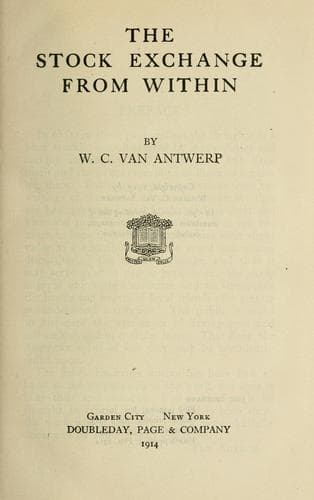
The Stock Exchange from WithinVan Antwerp, William C. (William Clarkson)
History
The Stock Exchange from Within
Van Antwerp, William C. (William Clarkson)
New York Stock Exchange; Stock exchanges
The greater part of the transactions are settled by a clearing system.
The Clearing Association is a separate organization, duly incorporated,
with a capital of $25,000. All members of the association must settle
daily by the clearing system; other members of the Exchange may do
so. The Clearing Association assumes responsibility for the trades
of all its members, and accordingly controls the exaction of margins
from members to each other, and may increase them at any time if the
fluctuations require it. The records of the clearings show day by day
the status of each member’s trading--how much he may be “long” or
“short” in the aggregate. Thus the members have a system of protection
against each other; the welfare of all depends upon keeping the
commitments of each within safe limits. The official margin system
operates as a commendable restraint upon over-speculation.
From our examination of the trading in mining stocks recently
introduced, we conclude that the lack of experience of this body in
this class of business has resulted in a neglect of proper safeguards
to the investor and an undue incitement to speculative transactions of
a gambling nature, and should not be tolerated on the Produce Exchange.
THE COTTON EXCHANGE
The New York Cotton Exchange was incorporated by a special charter in
1871. Its membership is limited to 450. It is now the most important
cotton market in the world, as it provides the means for financing
about 80 per cent. of the crop of the United States, and is the
intermediary for facilitating its distribution. In fact, it is the
world’s clearing house for the staple. Traders and manufacturers in
Japan, India, Egypt, Great Britain, Germany, France, and Spain, as well
as the United States, buy and sell here daily and the business is still
increasing.
Cotton is the basis of the largest textile industry in the world. The
business is conducted on a gigantic scale in many countries by means
of vast capital, complicated machinery, and varied processes involving
considerable periods of time between the raw material and the finished
product. Selling for future delivery is necessary to the harmonious and
uninterrupted movement of the staple from producer to consumer. Nearly
all the trading, beginning with that of the planter, involves short
selling. The planter sells to the dealer, the dealer to the spinner,
the spinner to the weaver, the weaver to the cloth merchant, before the
cotton of any crop year is picked. Dealers who take the risk of price
fluctuations insure all the other members of this trading chain against
losses arising therefrom and spare them the necessity of themselves
being speculators in cotton. The risks connected with raising and
marketing cotton must be borne by some one, and this is now done
chiefly by a class who can give their undivided attention to it.
GRADING OF COTTON
Public-domain text, read in full here on John Shaqi.
Reviews
Reviews
No reviews yet
Be the first to share your thoughts on this work.
Elsewhere in the archive
Join the Discussion
Join the discussion
Sign in to leave a comment or review.
Sign InorCreate an account