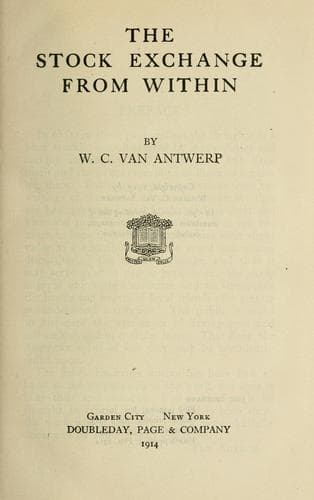
The Stock Exchange from WithinVan Antwerp, William C. (William Clarkson)
History
The Stock Exchange from Within
Van Antwerp, William C. (William Clarkson)
New York Stock Exchange; Stock exchanges
The grading of cotton is the vital feature of the trade. When no grade
is specified in the contract, it is construed to be middling. There
are now eighteen grades, ranging from middling stained up to fair.
This classification differs somewhat from that of other markets, and
last January the Department of Agriculture at Washington took up the
subject of standardizing the various grades for all American markets.
The New York Cotton Exchange participated in this work; a standard was
thus adopted, the types of which were supplied by its classification
committee. It varies but little from the one previously in use here.
The samples chosen to represent the several types are now sealed, in
possession of the Department of Agriculture, awaiting the action of
Congress.
The cotton plant is much exposed to vicissitudes of the weather. A
single storm may change the grade of the crop in large sections of the
country. It becomes necessary therefore to provide some protection
for traders who have made contracts to deliver a particular grade
which has become scarce by an accident which could not be foreseen.
For this purpose alternative deliveries are allowed by the payment of
corresponding price differentials, fixed by a committee of the Exchange
twice annually, in the months of September and November.
Settlements of trades may be made individually, or by groups of
members, or through a clearing system, the agency of which is
a designated bank near the Exchange. No record is kept of the
transactions, but it is probable that for a series of years the sales
have averaged fully 50,000,000 bales annually.
INORDINATE SPECULATION
There have been in the past instances of excessive and unreasonable
speculation upon the Cotton Exchange, notably the Sully speculation
of 1904. We believe that there is also a great deal of speculation of
the gambling type mentioned in the introduction to this report. In
our opinion, the Cotton Exchange should take measures to restrain and
so, far as possible, prevent these practices, by disciplining members
who engage in them. The officers of the Exchange must in many cases
be aware of these practices, and could, in our opinion, do much to
discourage them.
THE COFFEE EXCHANGE
The Coffee Exchange was incorporated by special charter in 1885. It has
320 members, about 80 per cent. active.
Public-domain text, read in full here on John Shaqi.
Reviews
Reviews
No reviews yet
Be the first to share your thoughts on this work.
Elsewhere in the archive
Join the Discussion
Join the discussion
Sign in to leave a comment or review.
Sign InorCreate an account