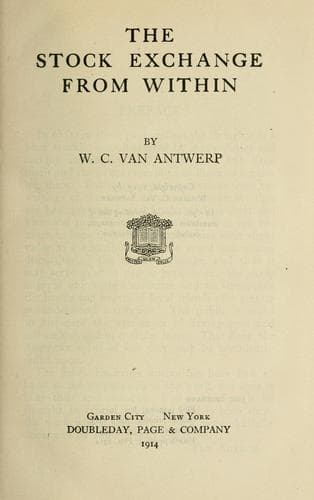
The Stock Exchange from WithinVan Antwerp, William C. (William Clarkson)
History
The Stock Exchange from Within
Van Antwerp, William C. (William Clarkson)
New York Stock Exchange; Stock exchanges
[9] If the discovery had then been made that bits of paper could be
used as a medium of giving mobility to capital, there would have been
a Stock Exchange at Rome eleven centuries before Christ. M. Edmond
Guillard’s study of the subject shows that the _argentarii_ (bankers)
were then doing business at the imperial city, and that in addition
to their central offices they had established branch offices at the
Forum, where they gathered daily at a specified hour, together with the
merchants, manufacturers, and capitalists, carrying on a business of
money-changing in a public market that was, in its essentials, similar
to our public financial markets of to-day (“Les Banquiers Atheniens et
Romains, trapézites et argentarii,” Paris, 1875 Guillaumin). As the
business was introduced into Rome by freed Greek slaves, it is perhaps
safe to say that the practice of dealing in public money markets is
in reality of still earlier origin. Plautus alludes to the crowd of
merchants and bankers in the public square, and many chroniclers record
the fact that at the time of Appius Claudius and Publius Sevilius, that
is to say, five centuries before Christ, there was a public market in
Rome known as the Assembly of Merchants (Collegium mercatorum).
[10] “A hundred years ago the use of the cheque was hardly known even
in London, and an English country gentleman would have had infinitely
more trouble in making a small investment than would nowadays a remote
Australian squatter, or a wheat-grower in the wildest West of Canada.
A letter posted to London from a distant village of Saskatchewan
in 1910 would arrive with far more certainty, and perhaps not less
speed than a letter posted in 1810 from a village in Sutherland or
Argyllshire. A penny stamp with a cheque enclosed in a brief letter
of instructions to the banker, and the thing is done. But the thrifty
Scot of 1810 would have had the utmost difficulty, and great expense
as well as risk, in converting a similar amount of cash savings into
an interest-bearing security. In 1710 the thing would have been
practically impossible. The Bank of England had only just been called
into existence, and, in fact, there were no bankers, no brokers, and
no Stock Exchange in the modern sense of the word. A man who wished to
invest, without personally employing his capital, had practically no
choice but to buy property and let it out at a rent, or lend his money
on mortgage. Bank of England Stock or National Debt had just begun to
be a political speculation for the moneyed Whigs in London. Merchant
venturers might risk a large sum in a joint-stock voyage. Otherwise the
average Englishman at the beginning of the eighteenth century A. D. was
hardly better off for investment than the average Athenian in the age
of Pericles, or the average Roman in the days of Cicero.”--“The Stock
Exchange,” by Francis W. Hirst, editor of the _Economist_, Williams and
Norgate, London.
Public-domain text, read in full here on John Shaqi.
Reviews
Reviews
No reviews yet
Be the first to share your thoughts on this work.
Elsewhere in the archive
Join the Discussion
Join the discussion
Sign in to leave a comment or review.
Sign InorCreate an account