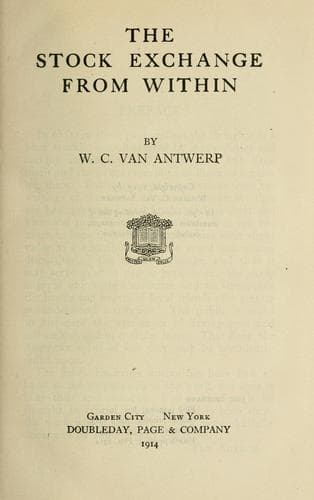
The Stock Exchange from WithinVan Antwerp, William C. (William Clarkson)
History
The Stock Exchange from Within
Van Antwerp, William C. (William Clarkson)
New York Stock Exchange; Stock exchanges
[11] Article on “Speculation” in Schonberg’s “_Handbuch der Politischen
Oekonomie_” (Tubingen, 1896–98).
[12] “Scope and Functions of the Stock Market.”--“The Annals of the
American Academy of Political and Social Science,” Vol. XXXV, No. 3.
May, 1910.
[13] Charles A. Conant, “The Uses of Speculation,” _Forum_ (August,
1901).
[14] Suppose for a moment that the stock markets of the world were
closed, that it was no longer possible to learn what railways were
paying dividends, what their stocks were worth, how industrial
enterprises were faring--whether they were loaded up with surplus goods
or had orders ahead. Suppose that the information afforded by public
quotations on the stock and produce exchanges were wiped from the slate
of human knowledge. How would the average man, how even would a man
with the intelligence and foresight of a Pierpont Morgan, determine
how new capital should be invested? He would have no guides except
the most isolated facts gathered here and there at great trouble and
expense. A greater misdirection of capital and energy would result than
has been possible since the organization of modern economic machinery.
“Wall Street and the Country,” by Charles A. Conant, pp. 92–93.--G. P.
Putnam’s Sons, New York, 1904.
[15] The student who wishes to go more thoroughly into the subject of
Stock Exchange usefulness is referred to “The Annals of the American
Academy of Political and Social Science,” Vol. XXXV, No. 3, May, 1910,
Philadelphia. “Some Thoughts on Speculation,” by Frank Fayant, New
York, 1909; “The Stock Exchange,” by Francis W. Hirst, London, Williams
& Norgate, 1911; “Wall Street and the Country,” by Chas. A. Conant,
New York, G. P. Putnam’s Sons, 1904; “Story of the Stock Exchange,” by
Chas. Duguid, London, New York, E. P. Dutton & Co., 1902; “The Stock
Exchange, London,” Methuen & Co., 1904; “The New York Stock Exchange,”
by Francis L. Eames, New York, 1894; “Der Deutsche Kapitalmarkt,”
by Rudolph Eberstadt, Leipzig, Duncker & Humbolt, 1901; “The Stock
Exchange,” (London), by C. D. Ingall & G. Withers, Longmans, Green
& Co., 1904; “A Simple Purchase and Sale Through a Stockbroker,” by
Eliot Norton, _Harvard Law Review_, Vol. VIII, No. 8; “Stock Exchange
Investments; History, Practice, and Results,” London, Simpkin,
Marshall, Hamilton, Kent & Co., 1900.
[16] The Stock Exchange is an organization of individuals formed for
the purpose of listing securities and for facilitating the sale and
delivery of stocks.... Through its agency corporations are enabled to
sell their shares and get the money capital to conduct their business.
The Stock Exchange has come into existence because of a demand for
trade facilities that will adjust differences of opinion in reference
to future values of corporation securities and give the purchaser some
idea of values. (“Modern Industrialism,” by Frank L. McVey, Professor
of Political Economy in the University of Minnesota. N. Y., 1904.)
Public-domain text, read in full here on John Shaqi.
Reviews
Reviews
No reviews yet
Be the first to share your thoughts on this work.
Elsewhere in the archive
Join the Discussion
Join the discussion
Sign in to leave a comment or review.
Sign InorCreate an account