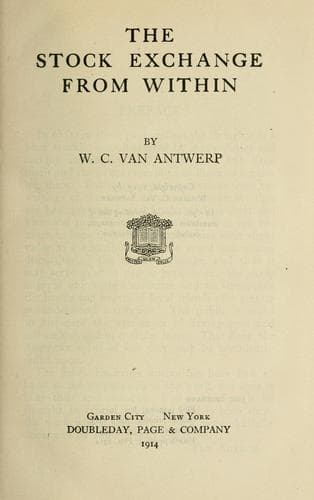
The Stock Exchange from WithinVan Antwerp, William C. (William Clarkson)
History
The Stock Exchange from Within
Van Antwerp, William C. (William Clarkson)
New York Stock Exchange; Stock exchanges
As we have not yet reached the point of abolishing property altogether,
we may concede that these great combinations can do for individual
business and for the country at large what cannot be done without
them. They furnish the large sums which, from time to time, are
required by the Government, the State, the town, the manufacturer,
the tradesman, and the speculator, and to each of these--especially
the speculator--the tremendous development of this country is due.
Because of speculation in securities, the 26,000 million dollars’ worth
of capital represented on the New York Stock Exchange by the stocks
and bonds of railroad and industrial corporations have found a public
market through which necessary capital has been raised, and the total
increases yearly by about one billion dollars. This is “big” business,
to be sure, but it is the bigness of the whole people, for the welfare
of each is the welfare of all.
Such large affairs naturally set people thinking; men want light; they
want to know, entirely aside from the doctrines of political platforms
and stump orators, to what extent the relation of capital to business
meets the test of proved effectiveness and economic worth. Especially
do they seek information in this oft-discussed matter of speculation in
securities and of the bank’s relationship to it; and here, fortunately,
there is no lack of results by which that relationship may be tested.
Pragmatism tells us that as phenomena appear, become mighty, and
persist in accordance with natural processes, so they demonstrate their
ultimate good and their obvious usefulness. In its especial application
to the matters we have discussed, pragmatism teaches us to wait for
results in estimating a particular business method, and then to study
it in its relation to _all_ business. Applying this test to the use of
loanable bank funds by those who deal or speculate in the things that
represent American enterprise, we find that the very existence of these
enterprises depends upon the maintenance of these methods. Finally,
both the banks and the Stock Exchange are the trustees of the property
of others, and in that capacity their reciprocal relations are certain
to be attended by greater caution than if they dealt in a freehanded
way with their own property. The magnitude of their undertakings spells
responsibility, and responsibility breeds sobriety.
CHAPTER V
PUBLICITY IN EXCHANGE AFFAIRS; CAUTIONS AND PRECAUTIONS
Public-domain text, read in full here on John Shaqi.
Reviews
Reviews
No reviews yet
Be the first to share your thoughts on this work.
Join the Discussion
Join the discussion
Sign in to leave a comment or review.
Sign InorCreate an account