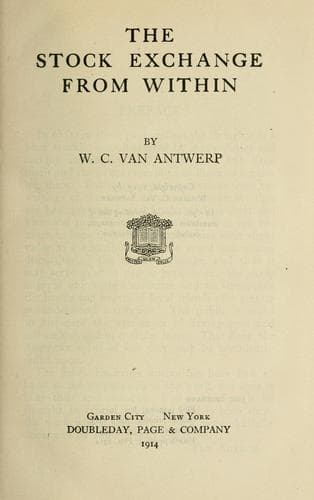
The Stock Exchange from WithinVan Antwerp, William C. (William Clarkson)
History
The Stock Exchange from Within
Van Antwerp, William C. (William Clarkson)
New York Stock Exchange; Stock exchanges
As a natural result, organization followed. Capital was consolidated,
the rights of owners were established, a great impulse was given
to various new forms of inventive genius and powerful commercial
enterprises of all kinds sprang into being. With this development the
market-places or Stock Exchanges without which capital could not
have been enlisted kept pace. It was found that transactions in the
securities which represented the people’s money should be rendered
easy, quick, and safe, and that the very essence of the Exchange’s
functions consisted in protecting the people who were the actual owners
of the enterprises by rules that would insure this result.
If we look about us to-day we find in all the great centres of the
world Stock Exchanges at work in this important field. We find that
just in proportion to the confidence which a country feels in the
strength and uprightness of such a market, so enterprise goes forward
with vigor, and so the national wealth increases. The success of one
enterprise in its appeal to public credit through the medium of the
Stock Exchange invariably leads to another; thus commerce and industry
develop. Securities in America alone, aggregate the enormous total of
forty-three billion dollars.[7]
Now, as our country’s entire physical properties are valued at one
hundred and thirty billions, it is apparent (after making allowances
for securities that are held by holding companies and hence are
duplicated in the foregoing estimates) that the nation’s securities
represent more than a third of the nation’s wealth. Again, almost two
million people are owners of these securities. The _Journal of Commerce
and Commercial Bulletin_ published Dec. 26, 1912, official statistics
for 247 of the large corporations. This tabulation revealed the fact
that the stock of these 247 corporations alone was owned by more than a
million stockholders, and it is therefore quite safe to infer that the
number of shareholders in all American companies approaches, if it does
not exceed, two million. I think it will not be disputed that where two
million people own a third of the nation’s wealth, they are entitled,
just as the farmer is, to a perfectly constructed price-making
machinery that will enable them to invest their savings, or sell their
holdings. Having learned the difficult lesson of saving their money and
the still more difficult one of increasing their surplus capital by
judicious investments, are not these people entitled to the safeguards
afforded by a Stock Exchange? “There is no other way in which true
prices can be made,” says Mr. Horace White. “If the quotations so
made are not precisely the truth in every case, they are the nearest
approach to it that mankind has yet discovered.”[8]
Public-domain text, read in full here on John Shaqi.
Reviews
Reviews
No reviews yet
Be the first to share your thoughts on this work.
Join the Discussion
Join the discussion
Sign in to leave a comment or review.
Sign InorCreate an account