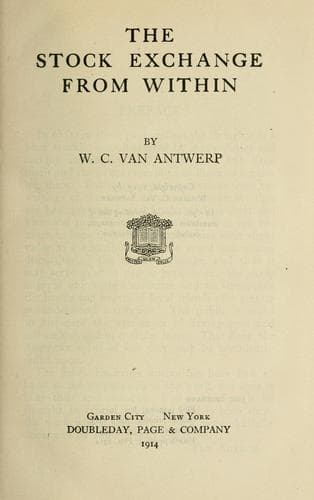
The Stock Exchange from WithinVan Antwerp, William C. (William Clarkson)
History
The Stock Exchange from Within
Van Antwerp, William C. (William Clarkson)
New York Stock Exchange; Stock exchanges
Now here is a strange thing. After a man has said, “Wall Street did it”
over and over again, he believes it, just as he believes or takes for
granted a similar tedious reiteration by the humble katydid. To such a
man, the thing he _wants_ to believe, when stated over and over again,
comes by repetition to fix itself in the mind as a demonstrated truth,
notwithstanding an utter absence of proof or of reasoning. He says
“Wall Street,” or “the Stock Exchange,” until he can think of nothing
else. It is a catch-phrase, short and sweet, which he hammers home to
his own ineffable satisfaction, and he thinks it and broods over it to
his heart’s content. The politician then comes along with his cures for
all the ills of society, and, finding Wall Street a convenient means of
perpetuating his accidental notoriety, his voice joins the harmony. The
indictment is then complete.
Take the panic of 1907 as the last and most conspicuous example. The
financial losses involved, and the extent of the disturbance of the
machinery of credit, made it the worst panic of this generation. As it
burst upon the country at a period when to the outward eye prosperity
reigned throughout the land, men were at a loss to explain it. They
could not understand how such appalling conditions could occur in
such apparently cheerful surroundings. As everybody was affected by it
in greater or less degree the whole country was full of people with
a grievance. They were themselves directly to blame for it, but they
looked elsewhere for the responsibility for their folly.
That sinister influences were at work was, in the popular mind,
undeniable; and by that same token we are pretty close to “Wall
Street” when we talk of things sinister. At about that time a member
of Congress made a speech in which he asserted, with all the art of
katydid repetition so dear to the heart of the true believer, that
the Stock Exchange was the cause of the panic. Rich men broke the
market and “held the bag,” he said, while panic-stricken owners of
property poured the invested savings of a lifetime into that capacious
receptacle. Nothing could be simpler. Newspapers must print such
things, and the public found what it wanted on the first page. Even
to-day, five years after the fact, this delightful explanation of the
1907 panic blossoms like the rose as a political campaign progresses.
The voice of the hustings “knows its business.”
Public-domain text, read in full here on John Shaqi.
Reviews
Reviews
No reviews yet
Be the first to share your thoughts on this work.
Elsewhere in the archive
Join the Discussion
Join the discussion
Sign in to leave a comment or review.
Sign InorCreate an account