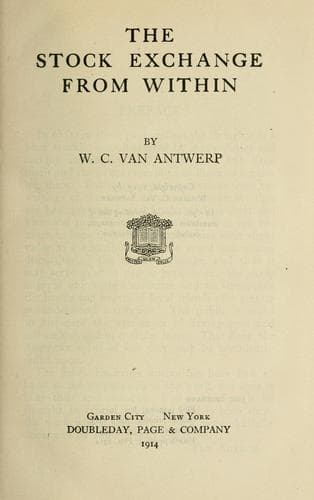
The Stock Exchange from WithinVan Antwerp, William C. (William Clarkson)
History
The Stock Exchange from Within
Van Antwerp, William C. (William Clarkson)
New York Stock Exchange; Stock exchanges
Mr. John Burroughs warns us that it is one thing to treat your facts
with imagination, but quite another thing to imagine your facts.
Sufficient time has elapsed since 1907 to soften, somewhat, the bias
and prejudice created by the events of that year, and perhaps there
may be among us minds open to reason. The New York Stock Exchange
feels, honestly, that a great injustice was done it by the criticism
and abuse so generously poured out in the first shock of that event.
Far from causing the crisis, its members assert that the institution
fulfilled one of its most useful functions in giving ample warning
of its approach, and that, when those warnings were disregarded, it
concentrated all its machinery on the task of restoring order from
chaos. They speak feelingly when they say that never in its history has
the Stock Exchange been called upon to deal with so great an emergency,
and never has it demonstrated so admirably its fundamental purposes.
When they make these statements they offer to prove them. Let us
examine the proofs.
The panic of 1907 was not unlike many preceding financial disturbances.
The opening months of the year had witnessed a general liquidation
on the Stock Exchange, brought about naturally, and in simple,
automatic compliance with economic laws and precedents. There had
been over-expansion in all lines of business; careful students saw
the portent; able men of power and influence heeded its warning
and set corrective forces in motion months before the shock came.
Total transactions in shares sold on the Stock Exchange had risen
from 187 millions in 1904 to 284 millions in 1906, while the value
of the securities thus sold increased from 12,061 to 23,393 millions
of dollars respectively. This was too rapid growth, and the general
liquidation that had been under way for months effectually corrected
it, since New York City bank loans secured by Stock Exchange collateral
declined, as shown by the Comptroller’s report, from $385,652,014 in
August, 1905, to $251,867,158 in August, 1907--a corrective force
represented by $133,784,856.
Public-domain text, read in full here on John Shaqi.
Reviews
Reviews
No reviews yet
Be the first to share your thoughts on this work.
Elsewhere in the archive
Join the Discussion
Join the discussion
Sign in to leave a comment or review.
Sign InorCreate an account