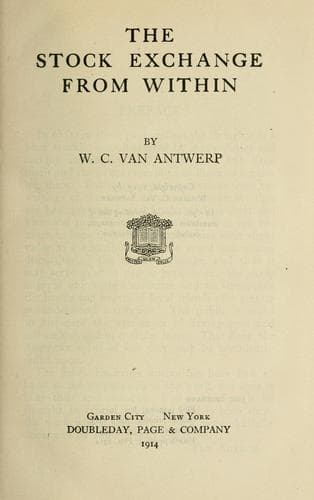
The Stock Exchange from WithinVan Antwerp, William C. (William Clarkson)
History
The Stock Exchange from Within
Van Antwerp, William C. (William Clarkson)
New York Stock Exchange; Stock exchanges
The Stock Exchange has been defined as “a barometer of future business
conditions,” and never did a barometer give clearer warning. It said in
effect to all the banks of the country and to business men generally:
“There has been a widespread over-expansion of credit; it must stop;
we are doing our share here in New York to correct it; you must do
likewise.” And, in order that there might be no failure to understand
what was meant, New York City bank loans were reduced with drastic
emphasis, months before the panic came, by nearly 35 per cent. “Without
an exception,” writes Prof. S. S. Huebner, “every business depression
in this country has been discounted in our security markets from
six months to two years before the depression became a reality.”[61]
Senator Burton, another authority, emphasizes the point further: “In
addition to other influences which promote an earlier rise and fall,
there must be mentioned the more careful study and attention to the
financial situation which is given by dealers in the stock markets
and in great financial centres. They often forecast the grounds for
a rise or fall in prices before the general public is awake to the
situation.”[62] This, then, was the situation in the summer of 1907.
The Stock Exchange had “cleaned house,” and had liquidated thoroughly,
warning the country to go slow.
Why was not this warning heeded? I recall vividly the daily expression
of surprise, on the floor of the Exchange, and throughout the financial
district, in the months that elapsed between our March liquidation
and the outbreak of the October panic, that the country should pay so
little attention to “Wall Street’s” admonition; that it should continue
its unprecedented boom despite the plain intimation that the funds to
support it were exhausted, and despite the general knowledge of every
tyro in business that future conditions are discounted in Wall Street
as freely as promissory notes.
Had the business interests of the country so much as inquired into that
warning they would have found by turning to the Comptroller’s reports
of the loans of national banks for the entire country that such loans
had expanded from $3,726 millions in 1904 to $4,679 millions in 1907.
They would have seen that whereas the New York City banks _contracted_
their loans by nearly $134,000,000 from August, 1905, to August, 1907,
loans and discounts by the banks of the whole country in that period
actually _expanded_ $700,000,000. Surely it will not be urged that
Wall Street or the Stock Exchange had anything to do with bringing
about this expansion. On the contrary, it shows that speculation in
commercial lines, in new enterprises, in lands and in all the various
forms that “out-of-town” banks are expected to finance, went on and
on in vastly increasing volume long after the danger signal had been
hoisted on the Stock Exchange, and in utter disregard of the warnings
those signals conveyed.[63]
Public-domain text, read in full here on John Shaqi.
Reviews
Reviews
No reviews yet
Be the first to share your thoughts on this work.
Elsewhere in the archive
Join the Discussion
Join the discussion
Sign in to leave a comment or review.
Sign InorCreate an account