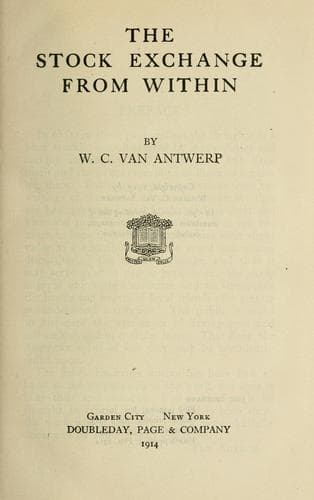
The Stock Exchange from WithinVan Antwerp, William C. (William Clarkson)
History
The Stock Exchange from Within
Van Antwerp, William C. (William Clarkson)
New York Stock Exchange; Stock exchanges
The details of the panic of 1907 are still fresh in mind, and need be
but briefly referred to. Banks and trust companies closed their doors
and suspended payments to depositors. Cash and credit became almost
unobtainable; we were face to face with demoralization. Clearing-house
certificates were resorted to at practically all banking centres
throughout the country; there was a general requirement of time notices
for withdrawal of savings bank deposits; all normal credit instruments
were impaired. The Secretary of the Treasury was forced to exercise
heroic discretion in the matter of security for government deposits and
for the very necessary increase of a note circulation that was then
suffering from a spasm of contraction. There was an immense hoarding
of funds and a consequent drying up of fluid capital, while from one
end of the country to the other, there was liquidation, business
contraction, retrenchment, panic, and ruin. “Wall Street” and the Stock
Exchange had foreseen that the chain was only as strong as its weakest
link, and had done what it could to prepare the public for the break.
To assert at this late day that it did aught but its full duty is
humbug _in excelsis_.
I have already cited one instance, the country’s expanding bank loans
as contrasted with “Wall Street’s” contraction, to show how plainly the
warning was conveyed. As another instance, take the immobilization of
capital tied up in the enormous real-estate speculation then prevalent.
In New York City alone the increase in mortgages recorded jumped from
455 millions in 1904 to 755 millions in 1905, an increase over the
previous years of 32.7 per cent, and 66 per cent, respectively.[68]
The figures showing the increase in building permits are similarly
significant, revealing the fact that in 1905, 1906, and the early
months of 1907, money was pouring into new construction at a rate
without precedent. In Greater New York alone, not including Queens
County, building permits granted in 1904 amounted to $153,300,000,
and in 1905 to $229,500,000, and in the face of disaster this rate of
increase continued up to the very eve of the panic.[69]
Outside of New York the expansion in building operations was equally
rapid and equally ominous, showing an _increase_ in twenty-five
cities alone from $201,300,000 in 1903 to $234,200,000 in 1904,
to $280,400,000 in 1905 and to $307,800,000 in 1906--all this but
a small part of the actual funds thus locked up throughout the
whole country.[70] We thus find that one of the most important and
inevitable causes of the panic was the absorption of exceptionally
large amounts of capital in enterprises that required a considerable
time for completion, or which, when completed, were not immediately
profitable; and to them may be added factories and extensive public and
private works of every kind. This form of expansion, as Senator Burton
points out, when carried to extremes almost invariably brings about a
disturbance.
Public-domain text, read in full here on John Shaqi.
Reviews
Reviews
No reviews yet
Be the first to share your thoughts on this work.
Elsewhere in the archive
Join the Discussion
Join the discussion
Sign in to leave a comment or review.
Sign InorCreate an account