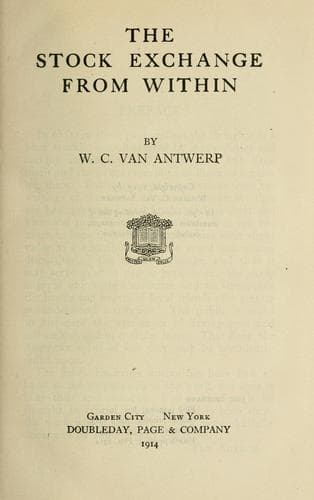
The Stock Exchange from WithinVan Antwerp, William C. (William Clarkson)
History
The Stock Exchange from Within
Van Antwerp, William C. (William Clarkson)
New York Stock Exchange; Stock exchanges
Now let us consider. Does all this expansion of bank loans outside of
New York and all this tremendous increase of building operations show
that the Samsons of “Wall Street” were pulling down the temple on their
own heads in order to slaughter the Philistines, as alleged, or does it
show an indifference and lack of readjustment to the growing stringency
of money, as revealed by the Stock Exchange in its liquidation of
March and April? “As a rule,” said John Mill, “panics do not destroy
capital; they merely reveal the extent to which it has been previously
destroyed by its betrayal into hopelessly unproductive works.”[71]
There would have been no such “betrayal” had judicious reflection and a
measurement of facts followed Wall Street’s warnings.
A shrewd man, one of the old school of New York City wholesale
merchants, who has nothing whatever to do with Wall Street or the Stock
Exchange, yet whose trade arteries extend to many parts of the country,
has long governed his business by the published reports of Stock
Exchange transactions. If he sees there revealed a wholesome, normal,
and conservative expansion in all lines of business and a money market
that betrays no uneasiness as to the future, he presses on into new
lines of endeavor, confident that the immediate future is serene. If he
finds an urgent liquidation on ’Change, with the coincident phenomena
of impaired credit instruments, he draws in his lines and waits. It
makes no difference to him who is rocking the boat, nor why; experience
has taught him that if it rocks, the time has arrived to go ashore. And
this steady old merchant, I have no doubt, is but one of a numerous
type.
Those who ignore the economic tides that ebb and flow through the
medium of the Stock Exchange as they did in 1907, do so because they
do not understand that these great market movements are really but
expressions of natural laws. If there is a rising tide--a boom--it is
attributed by thoughtless people to speculation and gambling. If there
is a bad break, it is caused by panic-stricken repentant sinners, or
by the activities of the bears. The essential point that is missed
here lies in the fact that, while bulls and bears alike may have their
brief hour, sooner or later, regardless of them, the market responds to
actual conditions and discounts the future of those conditions.
Public-domain text, read in full here on John Shaqi.
Reviews
Reviews
No reviews yet
Be the first to share your thoughts on this work.
Elsewhere in the archive
Join the Discussion
Join the discussion
Sign in to leave a comment or review.
Sign InorCreate an account