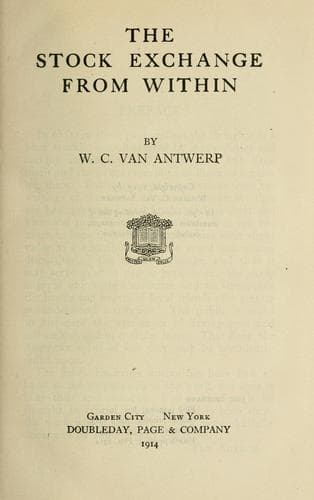
The Stock Exchange from WithinVan Antwerp, William C. (William Clarkson)
History
The Stock Exchange from Within
Van Antwerp, William C. (William Clarkson)
New York Stock Exchange; Stock exchanges
Whether we shall ever succeed in adopting it, or something like it, in
America, is the burning question in our banking offices to-day. Until
something is done, the layman who distrusts the plan of a central bank
and looks upon Wall Street with abhorrence, may find satisfaction
in knowing that the average New York banker is the most worried and
harassed man in American business life. With millions of other people’s
money in his possession subject to withdrawal by check at sight, and
with millions of the best security in the world in his vaults lying
absolutely idle and worthless so far as raising currency is concerned,
he stands between the devil and the deep-blue sea. Anything that
frightens his depositors, or even remotely suggests panic, gives him
a cold chill. People who talk of manipulation by New York bankers as
a cause of the panic of 1907 or any other panic are blind to the fact
that any disturbance of normal conditions is the one thing that bankers
would avoid as they would avoid the plague.
There was a third cause of the panic in the course pursued by the
President. In some quarters it is still termed “the Roosevelt panic,”
and there exists a belief that the President by his actions and
speeches played a large part in bringing about the crisis. Personally,
I feel that this has been exaggerated. There had been, unquestionably,
wrongdoing by certain corporation managers. The President, with a
characteristic vigor not unknown to politicians, seized upon it as
a theme for his speeches, and the “evils,” the “malefactors,” the
“corruption” and “dishonesty” with which he bruised the air, raised a
suspicion in many quarters as to the status and security of the whole
financial situation and undoubtedly contributed to the frightened
liquidation of the day. The impression these utterances produced
abroad, where American securities were popular, was painful, and led
one returning tourist to remark that Europe was acquiring the idea that
we were “a nation of swindlers.”
All panics are largely psychological, and this was no exception. The
President’s public speeches came at a time when emotion, apprehension,
and alarm filled men’s minds; and at a time when those irrational moods
were most likely to exaggerate the difficulties that existed, and to
conjure up difficulties that did not exist. Panics _seem_ to come from
lack of money, the real difficulty is lack of confidence, and it was to
this that the President’s course directly contributed.
Public-domain text, read in full here on John Shaqi.
Reviews
Reviews
No reviews yet
Be the first to share your thoughts on this work.
Elsewhere in the archive
Join the Discussion
Join the discussion
Sign in to leave a comment or review.
Sign InorCreate an account