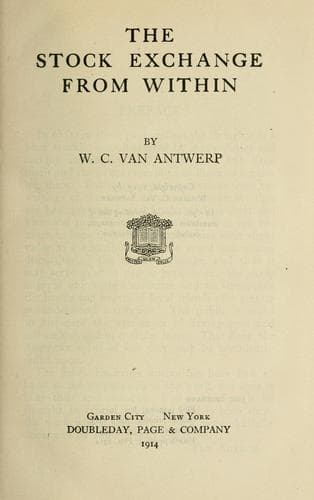
The Stock Exchange from WithinVan Antwerp, William C. (William Clarkson)
History
The Stock Exchange from Within
Van Antwerp, William C. (William Clarkson)
New York Stock Exchange; Stock exchanges
I am of the opinion that, judged by his public utterances, especially
his October speech at Nashville, Tenn., the President had not the
remotest idea that such an awful shock as the panic of 1907 was
imminent. He was not a student of economic conditions; he had no
familiarity with crisis-producing phenomena; he had never seen a
panic at close quarters. His speeches did not cause the panic, for
that disturbance was foreordained; they served, however, to hasten
it, to intensify it, and to keep it alive. Perhaps I may add that the
sparks beaten by him from the anvil of political expediency at that
unfortunate moment threw more light upon the President himself than
upon the evils he condemned. Perhaps, too, that was what the President
most desired. In any case, the fact remains that just as there is too
much confidence in times of excessive expansion, so there is too little
in times of unreasoning depression; and that the President’s attitude
aggravated the latter situations is undeniable.
But by what stretch of the imagination can the Stock Exchange be
credited with playing any part in this third cause of the panic?
If temporary depression results from exposure of wrongdoing among
railroad, industrial, or financial institutions, nowhere in the land
is execration poured forth upon the evil-doers more vigorously than
within its four walls. Far from complaining, the Stock Exchange and the
whole investment community welcome such exposures, despite their effect
on the market, for the precise reason that their own protection and
benefit, if nothing else, is promoted by it.
There was yet another reason for the panic, closely related to the
attitude of the President. I refer to the predicament of the railways
of the country as 1906 passed into 1907. Staggering under a load of
traffic which sorely taxed their equipment, the managers of these
properties cried aloud to the investing public for funds. But capital
was not to be had. Tied up in real-estate speculation and in quarters
whence it could not be easily recovered, the normal supply of capital
was immobile and inert. What was worse, encouraged by the attitude of
the President, an epidemic of radical anti-railroad legislation became
manifest in the several States, new and onerous burdens of taxation
were imposed, and a wave of distrust and suspicion regarding railway
investments was created. Simultaneously the cost of wages and materials
advanced--both characteristic phenomena indicating trouble--and, as
a consequence of all this blockade, the ratio of net to gross in the
matter of increased earnings fell from the normal proportion of about
40 per cent. in the first nine months of 1906, to less than 10 per
cent. in the same months of 1907.
Public-domain text, read in full here on John Shaqi.
Reviews
Reviews
No reviews yet
Be the first to share your thoughts on this work.
Elsewhere in the archive
Join the Discussion
Join the discussion
Sign in to leave a comment or review.
Sign InorCreate an account