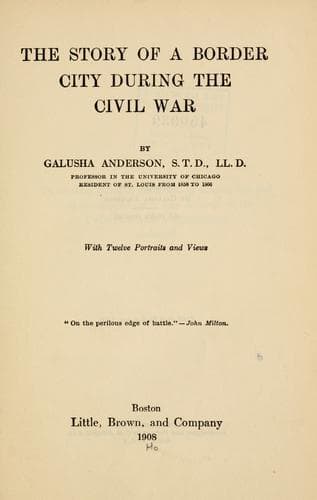
The story of a border city during the Civil WarAnderson, Galusha
History
The story of a border city during the Civil War
Anderson, Galusha
Missouri -- History -- Civil War, 1861-1865; Saint Louis (Mo.) -- History -- Civil War, 1861-1865
is doubtful if this great journal ever received its just meed of praise.
Noiselessly, day by day, it scattered in thousands of homes its message
in behalf of the Union. That message gradually cleared the vision of
those who read. Friends of the general government were multiplied by it.
It was a tremendous force for the right. Its influence for all that was
truest and best in government can no more be gathered up and weighed
than one can collect and weigh the sunbeams.
Its great rival, _The Missouri Republican_, was also a power, and, on
the whole, for good. It was exceedingly conservative, and by its
utterances did much to moderate and cool burning and unreasoning
passion. It seemed usually to be nicely balanced on the fence. It had
two editors, one a secessionist, the other a Unionist. The secessionist
was somewhat advanced in years and, after writing his editorial, left
his office for the day about four o’clock in the afternoon. The Unionist
editor was much younger, and wrote his editorial about nine o’clock at
night. And these two editorials, conservatively advocating opposite
views of the great national conflict, daily appeared side by side. But
this old and influential journal was very widely read, and, consistently
with its position of neutrality, published any decent and reasonable
article for, or against, the Union. Its constituency, though largely
disloyal in sentiment, read what it published on behalf of the Union. So
to their own advantage, as well as to that of the Federal government,
they were thus led to read and think much on both sides of the question
that was then dividing the nation. But the general public, deeming it a
weakness and a sign of duplicity to receive and publish all sorts of
articles, advocating the most diverse and contradictory views, with more
force than elegance dubbed this great paper, “The swill-tub.”
Nevertheless, it seems reasonable, all things considered, that to have
had then and there one such journal was a mighty power for good.
Early in the summer of 1861, when the people had become eager for war
news, some of the papers began to issue evening editions. This new move
was sensational simply because it was unusual. A wag, commenting upon
it, said, “They issue these evening editions to contradict the lies that
they tell in the morning.” But neither editors nor their critics,
especially in times of social upheaval and commotion, can at once
determine what among flying rumors is true and what is false.
Public-domain text, read in full here on John Shaqi.
Reviews
Reviews
No reviews yet
Be the first to share your thoughts on this work.
Elsewhere in the archive
Join the Discussion
Join the discussion
Sign in to leave a comment or review.
Sign InorCreate an account