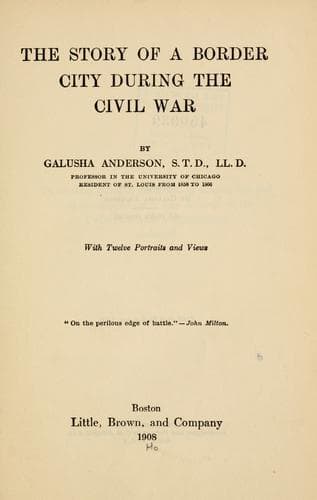
The story of a border city during the Civil WarAnderson, Galusha
History
The story of a border city during the Civil War
Anderson, Galusha
Missouri -- History -- Civil War, 1861-1865; Saint Louis (Mo.) -- History -- Civil War, 1861-1865
Now if we ask in what direction at the beginning of the war, the press
of St. Louis threw its influence, we see that taken as a whole, like the
pulpit, it was double-tongued. Some journals were for and some against
secession. Some were vacillating, at times both for and against—they
blew both hot and cold; some were simply bewildered; some
half-apologized for the rebellion; some were lost in the fog of State
sovereignty. The editors on either side of the national question, and
those on the fence, were doubtless honest; nevertheless their varied and
discordant voices confused the public mind. It was not strange that the
people were divided. They listened to a divided pulpit; they read the
deliverances of a divided press. But while amid this din of antagonistic
voices some were confused, many in downright earnestness began to think
for themselves, and in spite of the clashing utterances of the pulpit
and the press, at last thought themselves out of the mist into the clear
light of day.
CHAPTER IX
DECISION AND DIVISION
As soon as Camp Jackson had been taken, and the panic which so closely
followed it was over, a new spirit pervaded the entire community. Those
who had been halting between Unionism and secession felt almost
irresistibly impelled to decide with which party they would act. And
those who from the start had quietly but firmly allied themselves with
the one or the other, and for prudential reasons had refrained from
declaring their political faith, now felt constrained to show their true
colors. The process of open alignment was rapid. Society seemed to be
suddenly transformed. We felt as though we had been transported in a
state of unconsciousness to another world and when there had waked up in
astonishment, gazing upon new and strange scenes. At first some thought
that the celerity with which men were being converted to Unionism was
marvellous; but in this they were deceived. There were, to be sure, many
striking political conversions, but in the vast majority of cases, what
amazed observers was not conversion, but a frank and open declaration of
principles that up to that hour had been secretly held. Almost everybody
seemed to be confessing his political faith. The star-spangled banner
which, out of deference to the feelings of secession neighbors, had been
so long concealed, began to be hung out from the balconies and windows
of public buildings and private dwellings. It now waved from the cupolas
of schoolhouses and even from the steeples of some of the churches.
Union teamsters decked their mules and horses with it. Little children
on their way to school, or playing in the streets, carried it. Just as
sometimes in the spring the sudden coming of the warm sunshine and
showers stars the cherry and apple trees all over with blossoms, so our
city, so long bannerless, all at once bloomed with the Stars and
Stripes. Badges made of strips of red, white and blue were also
Public-domain text, read in full here on John Shaqi.
Reviews
Reviews
No reviews yet
Be the first to share your thoughts on this work.
Elsewhere in the archive
Join the Discussion
Join the discussion
Sign in to leave a comment or review.
Sign InorCreate an account