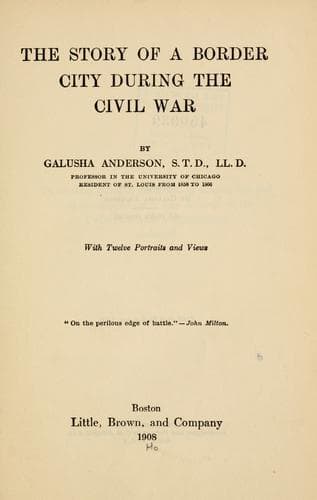
The story of a border city during the Civil WarAnderson, Galusha
History
The story of a border city during the Civil War
Anderson, Galusha
Missouri -- History -- Civil War, 1861-1865; Saint Louis (Mo.) -- History -- Civil War, 1861-1865
I should be glad to omit all reference to the bitterness of feeling that
pervaded the minds of many in St. Louis during the period of the war,
if, without mentioning it, I could faithfully present what was there
enacted. But it was an important factor in the life of that city so long
as the gigantic and heroic struggle to preserve the Union lasted.
Happily such intense bitterness as then confronted us has forever passed
away. As a mere reminiscence it is like a wasp in amber, interesting
perchance, but harmless.
We shall best enable the generation born since the war vividly to
apprehend the extreme virulence of not a few in St. Louis at that time,
by calling attention to some concrete examples of it.
Soon after the taking of Camp Jackson, when a multitude of national
banners, large and small, began to be displayed, a mother with her
little son, who was not more than five years old, boarded an Olive
Street horse-car. Some one had given to the little boy a tiny flag. Up
to that moment she had not observed it. When she caught sight of it,
before all in the car she cried, in anger, “Where did you get that dirty
rag?” Then snatching it from the hand of her child, she threw it upon
the floor as though it were a viper, and stamping it beneath her feet,
said in a rage, “Let me never see you touch that vile thing again.” Such
an exhibition of wrath against the Stars and Stripes seems to us now
astounding, but it was all too common then.
This extreme bitterness, early in 1861, began to manifest itself against
the Germans of the city, who, as we have already noted, with hardly an
exception were openly and stoutly opposed to secession. Those who
favored the Southern Confederacy seldom if ever called them Germans, but
usually denominated them, “the Dutch.” The intense contempt which, by
the tone of their voices, they injected into that simple phrase, “the
Dutch,” was marvellous. And this scorn for our German fellow-citizens
was especially manifested by the gentler sex. The secession women,
belonging to the best society of the city, often poured out their
vituperation on the loyal Germans. At parties and receptions, more than
once I heard them hotly denounce the Germans as Amsterdam Dutch without
the Amster. This was shocking then, it is almost unbelievable now.
Public-domain text, read in full here on John Shaqi.
Reviews
Reviews
No reviews yet
Be the first to share your thoughts on this work.
Elsewhere in the archive
Join the Discussion
Join the discussion
Sign in to leave a comment or review.
Sign InorCreate an account