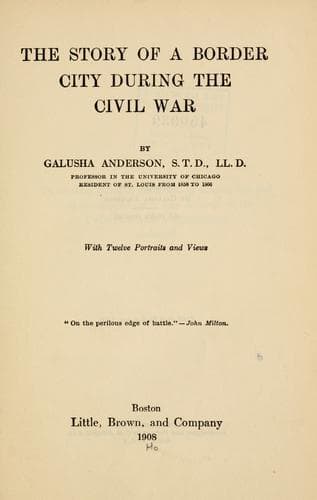
The story of a border city during the Civil WarAnderson, Galusha
History
The story of a border city during the Civil War
Anderson, Galusha
Missouri -- History -- Civil War, 1861-1865; Saint Louis (Mo.) -- History -- Civil War, 1861-1865
But even this pales before the irate utterance of a woman, who lived
hardly a block from my own door. A few weeks after the battle of
Wilson’s Creek, the body of General Lyon, who fell on that well-fought
field, was being borne through the city on its way for burial in his
native State of Connecticut. Some one said to this woman: “The hearse
with the body of General Lyon is coming down the street;” to which in a
flash she responded, “Good! if I had a piece of his liver, I’d fry it
and eat it.” Nobody but a woman could have compressed so much gall into
so few words. Shakespeare, who sounded the depths of woman’s soul, and
understood her power of passion as no other English writer ever did, in
his “Much Ado about Nothing,” put into the mouth of “Sweet Beatrice,” as
she raged against Claudio, “O God, that I were a man! I would eat his
heart in the market place.” What the prince of dramatists in imagination
attributed to woman, we saw in real life in St. Louis, in 1861.
If now in what we further relate in illustration of the bitterness of
feeling which for a season was manifested in our city, we shall find
amid the grave and solemn conflicts of civil war much that is ludicrous
and laughable, we must not forget, that by a merciful Providence this
tended to lighten burdens that otherwise might have been insupportable;
that the grave and the gay, the sad and mirth-provoking, the sublime and
the ridiculous often keep very close company, and that we are
responsible neither for the facts, nor for the strange juxtapositions in
which at times they presented themselves.
Into the two words, abolitionist and Yankee, a genuine Southerner and
secessionist, by his intonation and emphasis, condensed an amazing
amount of bitterness. To hurl either epithet at some despised Northerner
was the climax of vituperation. Nothing could be, nothing needed to be,
added. And such objurgation, harmless to the recipient, was often freely
indulged in, in our city.
I sat one morning in the study of Rev. G. J. Johnson, D. D., pastor of a
Baptist church on Sixth Street, when a Kentuckian came in to see us. In
a moment we saw that he was an ardent, impulsive soul. Without a break,
for some time he talked right on about the war and those who were
conducting the government. With rare volubility he denounced the
Yankees; but soon checked himself for a moment and asked if we were
Yankees? We assured him that we were not; so he went on with his bitter
tirade against the hated and despised Yankees. At last he stopped,
apparently to take breath, and asked, “Where were you born?” We replied
that we were both born and brought up in western New York. “Western New
York!” he excitedly exclaimed, “Western New Yorkers are the meanest kind
of Yankees!” We greeted his discourteous declaration with a peal of
laughter. At which he blushed, and, partially infected by our merriment,
with a smile, but without an apology, bade us good day.
Public-domain text, read in full here on John Shaqi.
Reviews
Reviews
No reviews yet
Be the first to share your thoughts on this work.
Elsewhere in the archive
Join the Discussion
Join the discussion
Sign in to leave a comment or review.
Sign InorCreate an account