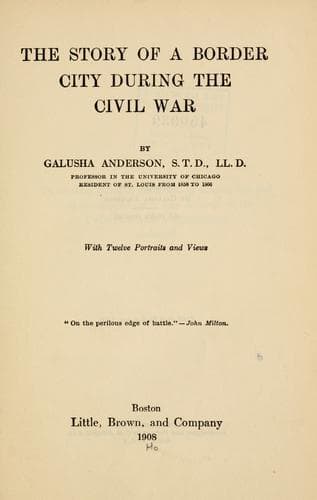
The story of a border city during the Civil WarAnderson, Galusha
History
The story of a border city during the Civil War
Anderson, Galusha
Missouri -- History -- Civil War, 1861-1865; Saint Louis (Mo.) -- History -- Civil War, 1861-1865
In my church and congregation were two bright, attractive Southern
women. In sentiment however they were politically divided; one was for
secession, the other was for the Union. In January, 1861, the latter, in
some way, discovered that she was a distant relative of Mr. Lincoln.
Thereupon she visited Springfield, and called upon him. He heartily
urged her to spend several days under his roof. She was delighted to
accept this cordial invitation, and was charmed with her new-found blood
relation. She returned to St. Louis full of enthusiasm for the President
elect, and embraced every fitting opportunity to lavish upon him her
praises. By chance she and the other woman of opposite political
sentiment, of whom I have spoken above, making a social call, met,
without any collusion, in my parlor. The conversation soon drifted into
a discussion of the ominous events which were then agitating all minds.
Very soon Mr. Lincoln was spoken of and the lady who favored secession
called him a clown and a mountebank. This brought her Southern friend,
who was a Unionist, to his defence. Her words had in them no tinge of
bitterness, but they were positive and cordial. She said that Mr.
Lincoln was a relative of hers, a warm personal friend, that she had
recently spent, by his urgent invitation, ten days in his house, and
that he was no clown; if she had ever met a kind, warm-hearted gentleman
he was one. To hear Mr. Lincoln so warmly eulogized as a gentleman, and
that by a Southern woman, was a little more than the secession lady
could endure. She burst into tears, and said in broken accents,
“I—can—never speak—to you again.” She rose to depart. Confounded by this
unexpected explosion of spleen, and hardly knowing whether I was at home
or somewhere else, I managed to help my tearful friend to the door,
where, as politely as I could, I bade her good day. She did not respond.
Her choking emotions forbade it. With her handkerchief to her eyes, she
went sobbing down the street, because one of her own dear friends had,
in the most lady-like manner, declared that Mr. Lincoln was not a clown.
Public-domain text, read in full here on John Shaqi.
Reviews
Reviews
No reviews yet
Be the first to share your thoughts on this work.
Elsewhere in the archive
Join the Discussion
Join the discussion
Sign in to leave a comment or review.
Sign InorCreate an account