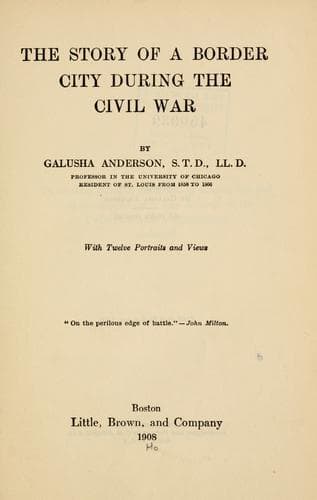
The story of a border city during the Civil WarAnderson, Galusha
History
The story of a border city during the Civil War
Anderson, Galusha
Missouri -- History -- Civil War, 1861-1865; Saint Louis (Mo.) -- History -- Civil War, 1861-1865
Belonging to the Presbyterian Church at the corner of Eighth and Locust
Streets was a good deacon by the name of Tucker. He was editor of an
evening paper. Believing with all his heart in the righteousness of
secession, and wishing both in season and out of season, to strike
telling blows against all advocates of Unionism, he came out in an
editorial, one Saturday evening, in which he said: “The devil preaches
at the corner of Sixth and Locust Streets, and he is just the same sort
of a being that he was more than eighteen hundred years ago; he wants
everybody to bow down and worship him.” Now since that was just where I
preached, the editorial was rather personal, and was intended to be
offensive. The deacon, fearing that I might miss reading his highly
complimentary words, and so lack the stimulus that they might impart to
my Sunday ministrations, early on the morning of the Lord’s day, sent a
copy of his paper to me by special messenger, having thoughtfully marked
his amiable editorial with his blue pencil. Instead of demanding
satisfaction of the pious editor as almost any hot-blooded Southerner of
that day would have done, the blue-penciled editorial was read at my
breakfast-table amid roars of laughter.
The good deacon a little while after left St. Louis, became a member of
Claybourn F. Jackson’s political family, fled with the Governor and his
staff to Arkansas and printed the proclamations of the discarded,
peripatetic government of Missouri, as it wandered here and there in
exile. About two years thereafter he died and, by the special permit of
the general in command of the department of Missouri, was buried from
the church where for many years he had filled the office of deacon. He
was an honest, earnest soul, striving according to his light to do his
duty.
Moreover, it fell to my lot not only to be at times the subject of
objurgation in secession newspapers, but the enemies of the Union also
honored me by threatening to take my life. On a June morning of 1861, a
gentleman accosted me at the Post-office, whither I had gone for my
morning mail, and with pardonable inquisitiveness and much earnestness
asked if I went out nights. I assured him that I did. He then urgently
advised me not to do so, saying that he knew that a plot had been laid
to kill me. I answered that I had very important duties as a Christian
pastor, and when in order to perform them it was necessary for me to go
out in the evening, I must go regardless of consequences to myself.
Although a stranger to me, he declared himself to be a friend, and that
he said what he did out of personal solicitude for me. He wished to know
if I were not afraid. I assured him that I had not the slightest
consciousness of fear; and that come life or death I proposed to stand
at my post and do my duty. He went his way and I went mine. Soon it
occurred to me that I did not ask his name, and who my solicitous friend
was I never learned.
Public-domain text, read in full here on John Shaqi.
Reviews
Reviews
No reviews yet
Be the first to share your thoughts on this work.
Elsewhere in the archive
Join the Discussion
Join the discussion
Sign in to leave a comment or review.
Sign InorCreate an account