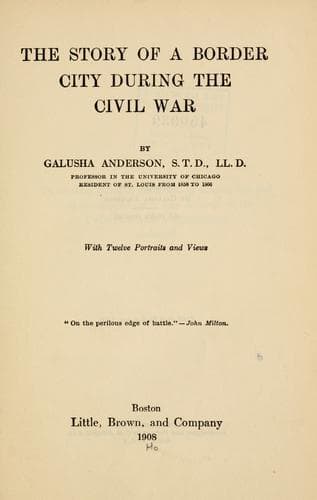
The story of a border city during the Civil WarAnderson, Galusha
History
The story of a border city during the Civil War
Anderson, Galusha
Missouri -- History -- Civil War, 1861-1865; Saint Louis (Mo.) -- History -- Civil War, 1861-1865
Very soon thereafter a neighboring pastor called upon me, and with
evident anxiety which expressed itself both in his words and in the tone
of his voice, detailed what he had heard about the planned assassination
of myself. He thought that I was in imminent danger and that perhaps it
might be best for me to leave the State. I replied that I suspected that
some of these gruesome stories had been invented to frighten me from my
post; and, if that was the design, the authors of them had missed their
mark. As for myself I had no apprehension of any special danger, and I
had settled the question as to what course I should take; it was my
unalterable purpose to go right on in the discharge of my duties as a
minister of the gospel and as a citizen of Missouri and of the United
States, if the heavens fell. What the foundation of these murderous
rumors was I never attempted to discover. Society in the city was
wrenched from its moorings, and was tempest-tossed. That some cherished
wild and bloody purposes was only too evident. Now and then a citizen,
under the darkness of night, was done to death in the street, and they
who did the deed of blood were never discovered. Men’s minds were filled
with apprehension. Their imaginations were weirdly active. No human mind
fully understood the situation; none but the divine mind could fathom
and comprehend it. No man could see the dangers that stealthily lurked
by his pathway; then as ever there was only one safe thing for any true
man to do, trust in God and fearlessly do his duty as he saw it day by
day.
In November of 1861, General Halleck took forcible possession of the
main rendezvous of the secessionists of the city and seized the arms,
furniture, books and papers that were found there. One book among others
stirred up no little excitement. In it were several pages of names of
our citizens. One column of names was written in red ink, the rest in
black. Upon investigation it was ascertained that it was the declared
purpose of the disloyal, who made the place their headquarters, when the
city should be taken by the Confederates, to seize those whose names
were written in red and, without trial, hang them from the nearest
lamp-post or telegraph-pole; while those whose names were written in
black were to be thrown into prison and tried by court martial. At the
head of the red list stood the flaming name of Frank P. Blair. Beneath
his many of us were permitted to read our names upon that blood-red roll
of honor.
Public-domain text, read in full here on John Shaqi.
Reviews
Reviews
No reviews yet
Be the first to share your thoughts on this work.
Elsewhere in the archive
Join the Discussion
Join the discussion
Sign in to leave a comment or review.
Sign InorCreate an account