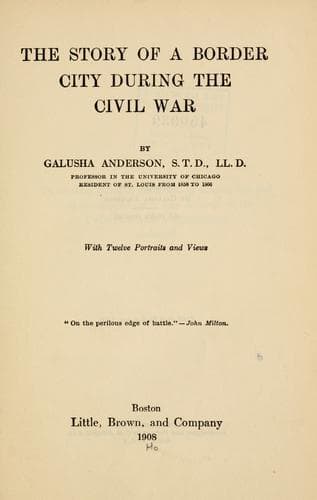
The story of a border city during the Civil WarAnderson, Galusha
History
The story of a border city during the Civil War
Anderson, Galusha
Missouri -- History -- Civil War, 1861-1865; Saint Louis (Mo.) -- History -- Civil War, 1861-1865
But, on the other hand, there were some masters who were conspicuous for
their kindness to their slaves. One of the deacons of my church was a
slaveholder. He was a Virginian by birth. His slaves came to him by
inheritance. He was a tall man with sandy hair and a mild blue eye. In
him, linked with sterling ability, were rare modesty and unusual
benevolence. Giving seemed to be a luxury to him. He contributed to
every good cause to the extent of his ability and often beyond what
could have been reasonably required of him. The suggestion of a smile
was always upon his lips. No one that observed it could ever forget it.
It was a part of the man; the outward expression of the sunshine of his
soul. And yet this noble, tender-hearted man held his fellow men in
bondage.
About two months after I became his pastor, in response to his cordial
invitation, one evening I dined with him. After the cheerful meal was
over, he took me aside into a private room, and to my astonishment and
delight said: “If you ever wish to say anything in the pulpit against
slavery you need not hesitate on my account; there are two things that I
abominate: one is selling liquor, and the other is selling niggers.”
Yes, he said “niggers;” they all did. He then told me that he had
inherited his slaves, and felt under solemn obligation to care for them.
He also declared that they were all manumitted, and that their
manumission papers were in a certain drawer in a bureau, which he
pointed out to me; so, if he should die, they would all be free. But he
said, “I do not wish them to know this. They are all young and I am
trying to train them, so that when they know that they are free and must
shift for themselves, they will be able to earn their own living. They
are well cared for; for the present I am the nigger of this household.”
So he was. Marshal Brotherton served everybody, even his own slaves.
Public-domain text, read in full here on John Shaqi.
Reviews
Reviews
No reviews yet
Be the first to share your thoughts on this work.
Elsewhere in the archive
Join the Discussion
Join the discussion
Sign in to leave a comment or review.
Sign InorCreate an account