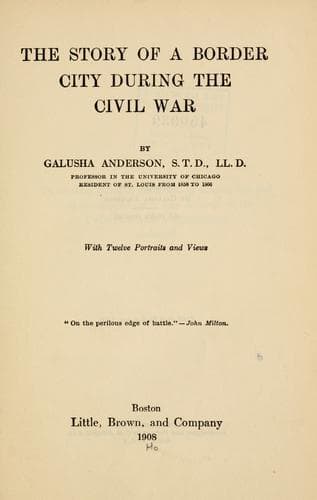
The story of a border city during the Civil WarAnderson, Galusha
History
The story of a border city during the Civil War
Anderson, Galusha
Missouri -- History -- Civil War, 1861-1865; Saint Louis (Mo.) -- History -- Civil War, 1861-1865
The instances of malignity now noted by us are but a few among many.
Still such bitterness was far from being universal. There seemed to be
comparatively little of it among the loyal. They were resolute, but not
often virulent. They were animated by confident hope. Few of them, after
Camp Jackson was taken, ever believed that Missouri would secede. They
however saw the need of constant vigilance. They coped with an able foe;
but feeling that their star was in the ascendant, they gave themselves
largely to works of charity, generously meeting the wants of both
friends and foes. On the other hand, the cause of the disloyal was
clearly on the wane. The fact was so evident that they were often in a
state of desperation. In such trying circumstances some of them gave way
to blind passion. Their better natures were overborne and some of them
expressed their pent up bitterness in hot, hasty words, or in despicable
deeds; still a large majority of them, in all the stress of the hour,
cherished and manifested a kindly spirit. But it has been necessary for
us, in order faithfully to depict society as it was in St. Louis during
the war, to present some of the many sad and startling exhibitions of
bitterness.
CHAPTER XI
SLAVES AND SLAVE-PENS
When the Civil War broke out, as we have before said, there were only
about fifteen hundred slaves in St. Louis. Among these the females,
specially demanded for domestic service, far outnumbered the males.
While the system of slavery was essentially barbarous and cruel, most of
these bondmen were kindly treated. Occasionally, however, some brutal
master gave vent to his passion and punished his slaves with
unreasonable and unbridled severity. A man of my acquaintance, who had
among his household servants a small colored girl, not more than fifteen
years old, for trivial offences, used to take her into the bath-room,
remove all her clothing, and then hold her for many minutes at a time
under the streaming cold water of the shower bath. Her cries, while
undergoing this torture, could be heard in the street and in the houses
of his neighbors. And while humane slaveholders denounced the savagery,
such was the law, and such was public sentiment, that nobody ventured to
take the part of the poor slave girl, while her owner and tormentor
gloried in his cruelty, evidently regarding the punishment as original
and a mark of his genius.
Public-domain text, read in full here on John Shaqi.
Reviews
Reviews
No reviews yet
Be the first to share your thoughts on this work.
Elsewhere in the archive
Join the Discussion
Join the discussion
Sign in to leave a comment or review.
Sign InorCreate an account