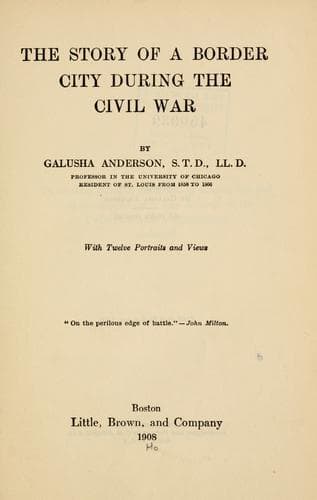
The story of a border city during the Civil WarAnderson, Galusha
History
The story of a border city during the Civil War
Anderson, Galusha
Missouri -- History -- Civil War, 1861-1865; Saint Louis (Mo.) -- History -- Civil War, 1861-1865
But this colored pastor had many sad, heart-breaking trials. This is one
of them. Two members of his congregation, a widowed mother and her
little daughter, were slaves in the family of a Presbyterian deacon. In
the autumn of 1860 the mother came to him, sobbing and wringing her
hands, because her master had determined to sell her to a New Orleans
slave-trader, and to retain in his own household her little daughter.
She must take her chances in the dreaded slave market, and be sold to
whom she knew not, a fate from which the slaves of the border States
shrank with untold horror, and must be torn from her only child, her
greatest earthly solace. But what could her pastor do? He too belonged
to the servile race, and in his boyhood had been a slave. Too vehement
protestation on his part would damage the case rather than help it. But
he fearlessly sought out her master, and pleaded as well as he could the
case of the distressed mother. Whatever the deacon may have felt as he
listened to the modest, earnest pleading of that great-hearted black
pastor, he inflexibly held to his resolution to sell his dark-skinned
sister in Christ; not that she had been an unfaithful or inefficient
servant, but because the deacon needed money, and as he thought must
have it. So he carried out his purpose. The day came when, with a
hundred or more consigned to the same pitiless fate, she boarded the
steamer at the levee to be carried to her doom. Her little slave
daughter was there to give her the last tearful kiss and embrace. Her
faithful pastor stood by filled with sorrow and deep down in his soul
hot with righteous wrath. The steamer moved out from the levee, the
anguished mother and the pastor waved to each other their red bandanas,
and slowly the vessel with its freight of sorrow disappeared down the
river.
Immediately after, I met this pastor with his burden of grief, and he
told me the sad tale. He said: “Think of it! she came to me for comfort.
And I did the best I could.” I said to him, “I don’t see what you could
have said to comfort her.” He replied, “There was not much that I could
say; but I did tell her that God was down there as well as up here, and
in some way he would take care of her, and that when she got to heaven,
where the wicked cease from troubling, she would not find that
Presbyterian deacon there to torment her.” He uttered this in dead
earnestness, and with a solemn gravity befitting the heart-breaking
story, seemingly without the slightest consciousness of the mingled
humor and sarcasm of his last declaration.
Public-domain text, read in full here on John Shaqi.
Reviews
Reviews
No reviews yet
Be the first to share your thoughts on this work.
Elsewhere in the archive
Join the Discussion
Join the discussion
Sign in to leave a comment or review.
Sign InorCreate an account