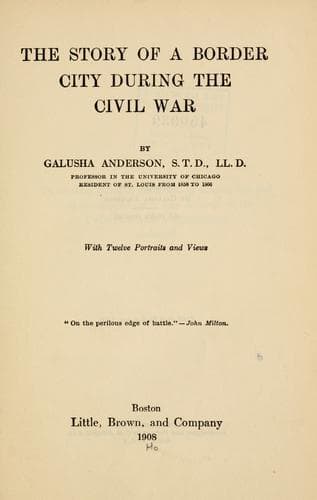
The story of a border city during the Civil WarAnderson, Galusha
History
The story of a border city during the Civil War
Anderson, Galusha
Missouri -- History -- Civil War, 1861-1865; Saint Louis (Mo.) -- History -- Civil War, 1861-1865
Belonging to my congregation, though not a member of my church, was a
banker and slaveholder. He was a Mississippian by birth and education,
and profoundly believed in the righteousness of slavery. Knowing that I
came from the North, he set out to convince me that African slavery was
not only right, but beneficent and beautiful. But he little suspected
how difficult the job was that he had undertaken. However, to attain his
object, he proceeded in a cautious, artful manner. He invited me and
mine to dinner. It was a very natural move for a man to make in
reference to his pastor. But once warmly welcomed under his roof and to
his table loaded with the best from the market, his unseemly ardor in
setting forth the attractiveness of the “peculiar institution” slightly
revealed his ulterior purpose in making me a recipient of his bountiful
hospitality. But the dinner was good, his wife was a charming hostess
and his young daughters were winsome. Under the circumstances it became
me to be a good listener, to make some commonplace remarks, and to ask
questions with an air of innocence. This seemed to encourage mine host,
and he set forth with much particularity and with the accent of
conviction the manifold benefits of slavery as it existed in the United
States. I made no adverse comment, which incited him to illustrate the
beauties of human bondage by the condition of the slaves in his own
household. He was the proud owner of two. One of them was a mulatto,
over six feet in height, and between twenty-five and thirty years of
age. He was good-looking, and evidently a man of energy and decision. My
host said, “Did you see Wash when you came in?” I assured him that I
did, and that I was very much impressed by him. “Well,” he said, “Wash
has been with me for many years; I think a great deal of him, and he is
warmly attached to me and my family. Nothing could persuade him to leave
me. I have perfect confidence in him. He is also a man of good judgment.
I never buy a horse or trade horses unless I first get Wash’s opinion.”
And so he went on extolling his slave, who seemed to me to be a manlier
man than his master.
Having exhausted the subject of Wash, he began to dilate on Mammy. “Did
you notice her?” he said. “She waited on the table. She has nursed these
daughters of ours, and loves them as though they were her own children
and they love her. Why, sir, she is so attached to her home and to us
all that nothing could tempt her to leave us.” Well, to hear mine host
talk, if one had never known anything about slavery except what he set
forth, it could not but have been considered in some respects a
beneficent institution.
Public-domain text, read in full here on John Shaqi.
Reviews
Reviews
No reviews yet
Be the first to share your thoughts on this work.
Elsewhere in the archive
Join the Discussion
Join the discussion
Sign in to leave a comment or review.
Sign InorCreate an account