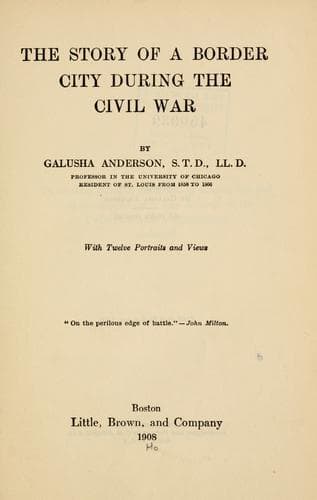
The story of a border city during the Civil WarAnderson, Galusha
History
The story of a border city during the Civil War
Anderson, Galusha
Missouri -- History -- Civil War, 1861-1865; Saint Louis (Mo.) -- History -- Civil War, 1861-1865
the hammer till the fall of the curtain of darkness put temporary end to
the shameless work.
A man connected with this pen defended the breaking up of families by
the sale of slaves. He said that black mothers and children did not much
mind being separated; that they had little, if any, real affection for
each other; it was very much like separating a cow and her calf. A
little while after, at that very slave-pen, I saw the disproof of his
words. A man had just bought there, at private sale, a little boy about
ten years old. The lad’s mother was with him. As he was taken away from
the pen, he began in his grief to howl as though his heart was breaking.
After he had been taken about two squares, his purchaser, annoyed by the
wailing, returned with him to the pen, secured the loan of his mother
till he could get his tearful chattel to his home, without attracting a
curious and sympathetic crowd on the street. Once there his little slave
could be quieted by a sugar plum or a whip. When the lad was at last
under the roof of his new master, the bereft and sobbing mother was led
back to the desolate pen to be sold to some other master in the city or
State, or to some trader who would take her down to the rice or cotton
plantations of the South.
But when the war came on, there was no longer any demand for slaves. The
traffic in human beings suddenly ceased. Lynch shut up his pen. The
military authorities seized the pen at the corner of Fifth and Myrtle
Streets and transformed it into a military prison. No little colored boy
or girl was ever again to be sold there. The place hallowed by the sighs
and tears of bondmen and of motherless children was for a time to become
the prison-house of those who had bought and sold their fellow men, and
were now waging unholy war against the very government that had
protected them and their slaves,—the government that had complacently
caught and returned to them their chattels who had attempted by flight
to cast off their bondage and secure freedom for themselves and their
children amid the frosts and snows of Canada.
One morning in 1862, an old negro, who for many years had been a drayman
for a mercantile firm on Second Street, was full of merriment. He was
overheard mumbling something to himself and every now and then breaking
out into a laugh. His employer said, “Joe, what is it? What’s the
matter?” He responded with a chuckle, “Strange tings happen des days!”
“So, what things?” “You kno’s dat slave-pen, corner Fifth an Myrtle?”
“Yes.” “Well, de col’ed folks used to carry in tings dar fo der chillen
to eat. Dis mawnin, boss, I seed white folks carrying in tings for der
folks to eat. Ha! ha! strange tings happen des days.” Sure enough, the
tables were turned. Wrongs were being righted. Justice, poetical
justice, was being meted out. “With what measure ye mete it shall be
measured to you again,” saith the Lord.
Public-domain text, read in full here on John Shaqi.
Reviews
Reviews
No reviews yet
Be the first to share your thoughts on this work.
Elsewhere in the archive
Join the Discussion
Join the discussion
Sign in to leave a comment or review.
Sign InorCreate an account